






In lighting stores, galleries and commercial spaces, choosing lighting equipment is only part of the job. How to install and place the rails can have a direct effect on the quality of light, the beauty of the space and the cost of maintenance. Surface and pendant magnetic light rail There are two widely used methods for implementing flexible lighting systems that allow changing the position of the lights according to the layout of the environment.


In the facing method, the rail is installed directly on the ceiling or suitable surface; But in the hanging method, the rail assembly is placed at a certain height from the ceiling using cables or supporting equipment. Both methods have their advantages and limitations.
In this guide, magnetic rail installation steps, infrastructure requirements, power supply selection, safety tips, and common mistakes in commercial projects are reviewed to make decisions and implement lighting systems more accurately.
Why is magnetic rail suitable for lighting commercial spaces?
In a clothing store, the arrangement of products may change every season. Art galleries also need a different angle and position of light for each exhibition. In such spaces, using a fixed lighting system can make subsequent changes difficult and costly.
The magnetic lighting system reduces this limitation to a great extent. In this system, the rail plays the role of the mechanical and electrical substrate of the lights, and it is possible to use different lighting modules on it.
The most important advantages of this system in commercial projects are:
- The possibility of changing the position of the lights according to the arrangement of the products
- Combining line lights, spots and other compatible modules
- Reducing the need to change fixed wiring when modifying lighting
- Creating regular and harmonious lighting lines with the interior architecture
- The possibility of developing the system within the allowed capacity of the equipment
Of course, achieving these benefits depends on the correct selection of rails and equipment. For example, in projects where several commercial spaces are equipped with similar specifications, the coordination of the rail model, fittings and lights is very important.
For this reason, contractors and project managers when considering options Wholesale distribution of magnetic light rail In addition to the price and the required number, they should also check the compatibility of the equipment, installation method, electrical capacity and access to side connections.
What is the difference between the installation of a magnetic light rail and a pendant?
The choice between ceiling and pendant installation should be made based on ceiling height, architectural conditions, type of use and lighting purpose.
Installation of surface magnetic rail
In this method, the rail profile is installed on the surface of the roof or suitable infrastructure with the help of screws or special fasteners. This method is used for projects where the final ceiling is implemented and it is not possible to create a groove for the installation of the built-in. Cladding rails are usually used in the renovation of shops, offices, showrooms and small galleries.
Among its most important advantages, we can mention the relative speed of implementation, proper access for repairs, and no need for extensive destruction of the roof. However, the material of the roof determines how the rail should be restrained. Installation on concrete, metal structure and false ceiling is not necessarily done in the same way.
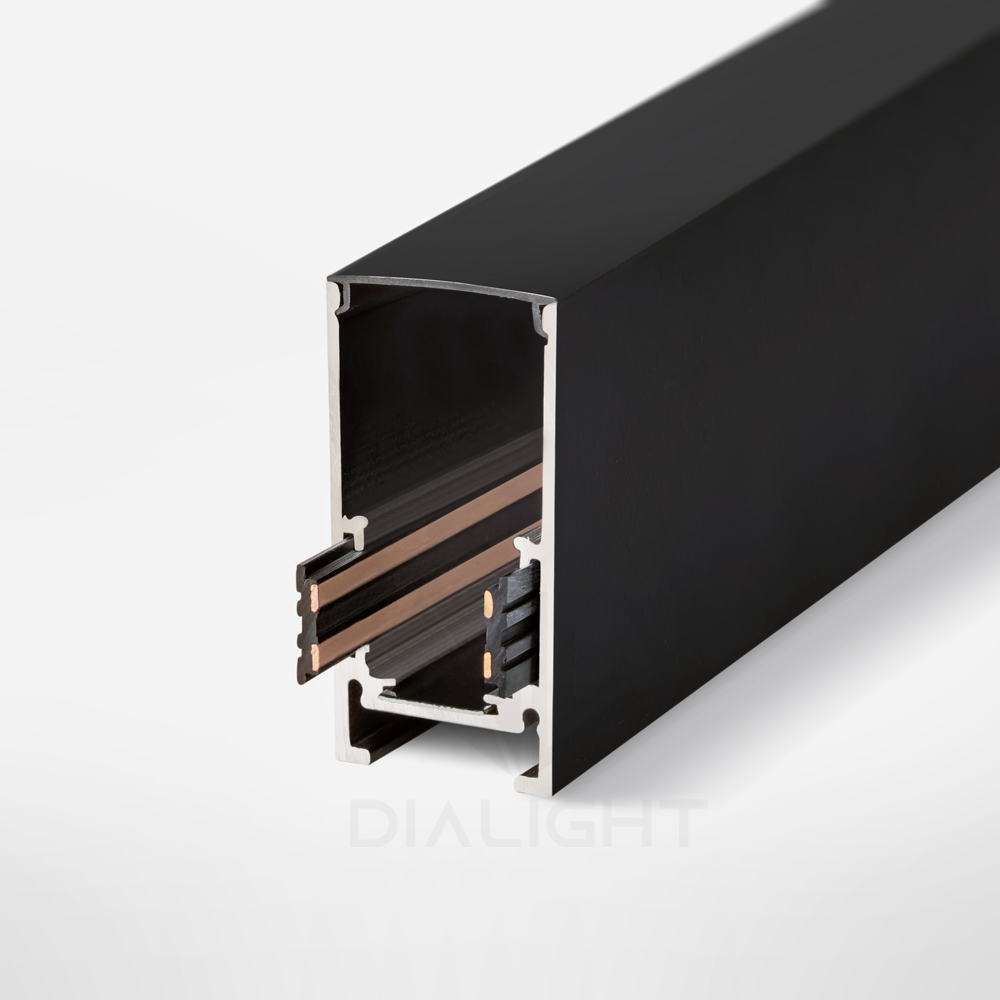
Installing a hanging magnetic rail
In the suspension system, the rail is suspended from the roof structure using a steel cable, rod, or a special holding assembly. This method is especially used in spaces with high ceilings; Because the location of the lights can be made closer to the desired surface. For example, in a gallery with a high ceiling, mounting lights high above the ceiling may make it difficult to control the light on the panels. Using a hanging rail can move the position of the lights to a more suitable range.
Of course, the execution of the pendant requires a more detailed investigation in terms of the weight of the set, the number of connection points, balance and mechanical safety.
Technical comparison of two installation methods
Quality | Coated magnetic rail | Hanging magnetic rail |
location | on the roof surface | lower than the ceiling |
infrastructure | Connection to a suitable surface or structure | Harness to the load-bearing structure |
suitable for | Renovation and conventional roofs | High ceilings and open spaces |
Height adjustment | limited | Adjustable in some models |
Installation complexity | Usually less | more |
Need for hanging equipment | does not have | has |
Common usage | Store and office | Gallery, showroom and commercial space |
Step-by-step tutorial on how to install magnetic surface light rail
Installing the facing rail is simple in appearance. The following steps are a general framework and do not replace the model selection instructions or the execution of a professional electrician.
First step: positioning and marking
First, the installation route is determined according to the lighting map on the ceiling. The use of laser alignment on long tracks, especially in spaces with multiple parallel rails, helps to increase accuracy. At this stage, the distance of the rail from the wall, ventilation equipment, facility vents and other roof components should also be controlled.
Second step: preparation of connection points
After the path is determined, the location of the fasteners or retaining screws is determined. The distance between the connection points is not a fixed number for all models and should be chosen according to the length of the rail, the weight of the set, the capacity of the fasteners and the manufacturer’s instructions. For installation on a false ceiling, it is necessary to transfer the load to a suitable substructure. Direct connection to gypsum boards without verifying the bearing capacity is not a reliable solution.
The third step: installing and aligning the rail
The rail is placed on fasteners or joints and restrained in the manner specified by the manufacturer. In multi-piece tracks, the connection of the profiles should be checked mechanically and electrically. Even a slight height difference between two pieces of rail can make the appearance of the lighting line irregular or make it difficult to move and install the modules. Before the final tightening of the connections, check the straightness of the path and the alignment of the parts.
Step 4: Connect electricity and power supply
Wiring must be done by a qualified person after disconnecting, securing and verifying that the circuit is de-energized. Many common magnet systems operate at low voltages, such as 48 V DC; But the exact value of the voltage should be extracted from the specifications of the same system. The input of the power supply is connected to the building’s power grid and the output is transferred to the rail according to the system design. The power supply installation location must have proper access for service, adequate ventilation and environmental conditions approved by the manufacturer.
Step 5: Install the lights and launch
After completing the mechanical installation, checking the connections and the necessary electrical tests, the compatible lights are placed on the rail. The connection mechanism may have a mechanical lock in addition to the magnet. Therefore, it is necessary to ensure the full engagement of the retainers. At the end, the brightness of each lamp, performance stability and radiation angle are checked according to the map.

Technical steps of installing the hanging magnetic light rail
In terms of electrical principles, pendant installation has similarities with surface installation, but the design and implementation of the support system becomes more important.
First step: determining the installation height
The height of the pendant should be chosen according to the height of the ceiling, the traffic path, the type of light and the surface to be lit. For example, in a furniture showroom, the rail can be placed at a height to better control the distribution of light on the products. But in public and high-traffic routes, it is necessary to maintain the free height and prevent people or equipment from hitting the hanger assembly. The choice of height should not be made solely on the basis of appearance.
The second step: determining the anchoring points and installing the cables
In this step, the connection point of hanging cables to the structure is determined. The number of anchoring points, the distance between them and the load bearing capacity should be determined based on the specifications of the hanging kit, the total weight of the set and the conditions of the roof. For long tracks or sets with angled connections, balance control is especially important. Use cables and connectors that are designed for this purpose. Equipment without load capacity specification should not be selected as the main holder.
The third step: placing the rail and setting the level
After installing the supporting equipment, the rail is placed in the designated position. In systems with adjustable cables, the length of the cables must be adjusted so that the rail remains level throughout the entire route without twisting. In addition to reducing the visual quality, the existence of the level difference may cause the improper distribution of the load between the suspension points. It is better to control the final balance after placing the equipment and considering the actual weight of the set.
The fourth stage: power transmission and completion of connections
The method of power supply in the suspension rail depends on the design of the system. Some sets use an independent power cable and some others have special power transmission equipment. It should not be assumed that every hanging cable can transmit electric current. Electrical connections, cable routing and power supply must be implemented according to the equipment instructions. In the end, the mechanical strength and correct electrical performance are checked before operation.
Common mistakes when installing magnetic light rail
1. Rail installation without checking the roof capacity
Attaching a hanging rail or cable to an improper infrastructure can cause the connections to loosen or create a fall hazard.
Solution: Before implementation, the capacity of the structure and supporting equipment should be checked and the connection type should be selected according to the project conditions.
2. Using incompatible lights and rails
The apparent similarity of two magnetic systems does not mean that they are compatible.
Solution: The dimensions, voltage, location of the conductors and the locking mechanism of the lamp should be adapted to the rail.
3. Incorrect choice of power supply
Inappropriate driver may cause lights not to turn on, unstable operation or overheating of the equipment.
Solution: Calculate and control power consumption, voltage, current and power supply installation conditions before purchase.
4. Ignoring the place of equipment service
Hiding the driver in a place where it can’t be safely and conveniently accessed later makes repairs difficult.
Solution: Access for service and ventilation requirements should be anticipated from the design stage.
5. Installing lights without lighting design
Even with the correct implementation of the rail, the wrong choice of angle or position of the lamp can cause undesirable shadows and uneven lighting.
Solution: Before delivery, the lighting condition should be checked and adjusted in the actual conditions of using the space.
Quality control checklist before project delivery
under review | The purpose of control |
Alignment of rails | Avoid apparent inconsistency |
The strength of fasteners and cables | Ensure mechanical safety |
Light and rail compatibility | Correct connection and operation |
Power supply specifications | Prevent improper loading |
Electrical connections | Ensuring the safety and continuity of the circuit |
All lights work | Identify possible failures |
Angle and distribution of light | Adapting to the lighting scheme |
Access to the driver | Facilitate service and maintenance |
How to manage the cost of implementing magnetic rail in commercial projects?
The cost of a magnetic lighting system is not limited to the price per rail meter. The cost of lights, connections, power supplies, infrastructure, hanging equipment and execution force should also be included in the estimate. In multi-unit projects or chain stores, choosing the same and compatible equipment can simplify the supply, installation and maintenance process. Also, preparing a detailed list of items before purchase reduces the possibility of ordering incomplete equipment or rework.
For example, if the number of connectors or the location of the power entry is not specified during the design phase, it may be necessary to change the route or provide additional parts during installation. In such projects, technical advice before purchase becomes more important. Suppliers like Dialight Lighting Industries who are active in the field of lighting equipment, can be one of the options to consider for providing rails and related items; With the condition that the technical specifications of the products are adapted to the requirements of the project.
Frequently asked questions
Is the surface magnetic rail installed on the roof of Kenaf?
Yes, but the connection must be designed according to the load of the assembly and the roof substructure. Relying on the plasterboard without checking the load bearing capacity is not a good method, and if necessary, it should be connected to the supporting structure.
What is the main difference between the installation of hanging magnetic rail and facing?
In facing installation, the rail is placed directly on the suitable surface or substructure; But in the hanging method, the rail is separated from the ceiling with the help of supporting equipment. Choosing the right method depends on the height of the ceiling, architecture and lighting design.
Do all magnetic rails work with 48V electricity?
no Although 48V DC systems are common, not all models have the same voltage. Before connecting the electricity, the specifications of the rail, lamp and power supply should be checked.
Is it suitable to install a hanging magnetic rail for a high ceiling?
In many projects, yes. Installing the pendant allows lowering the position of the lights; But the final height, structural load and safety requirements must be considered in the design.
Do you need an expert electrician to install a magnetic rail?
yes Despite the simplicity of installing some light modules, the implementation of electrical connections, the selection of protective equipment and the safety test of the system must be performed by a qualified person.














گفتگو در مورد این post