


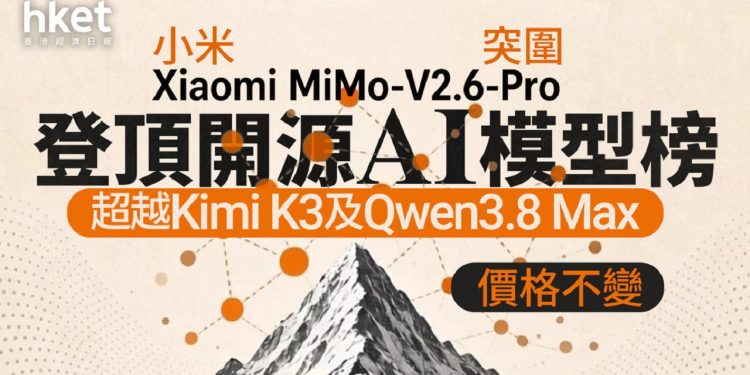

In a surprising move, Xiaomi introduced the MiMo-V2.6-Pro model, the latest generation of the MiMo language model family, surpassing Dipsik.
According to the report One-stop artificial intelligence serviceThis model scored 46 points Intelligence Index Artificial Analysisbecame one of the most powerful and, based on this evaluation, the best OpenVite model in the world.
A score of 46 puts Xiaomi’s new flagship ahead of proprietary models such as xAI’s Grok 4.6 with a score of 44 and Google’s Gemini 3.8 Flash with a score of 41 in the current Artificial Analysis scoring method. Also, the MiMo-V2.6-Pro model with Grok 4.7, which was introduced at the same time and got the same score of 46, is on the same level and is higher than the Chinese OpenWeight models DeepSeek V4.1 Flash with 39 points and DeepSeek V4.1 Pro with 36 points.
The importance of this achievement is not limited to the fact that Xiaomi is more known in the global market for smartphones, electric cars and electronic products. More importantly, MiMo-V2.6-Pro is an MIT-licensed OpenWeight model, and the cost of using it through Xiaomi’s API is significantly lower than many proprietary models at the same performance level.
Read more: Alibaba’s new chip was introduced
As a result, independent developers and enterprises can download MiMo-V2.6-Pro for free from Hugging Face, customize or fine-tune it for their specific applications, run it on personal or leased hardware, and deploy it in their operational environments; Without paying a fee to Xiaomi for this direct use. Xiaomi’s API is also available, and the cost is among the cheapest options per million tokens, although for organizations limited to using servers located in China, this option may present challenges.
Xiaomi charges $0.435 for every million uncashed incoming tokens and $0.87 for every million outgoing tokens. Artificial Analysis has estimated the cost of this model to be 0.13 dollars for each task in the intelligence index and the output production speed is about 134 tokens per second. Also, the MiMo-V2.6-Pro model supports one million token background window and text, image, audio and video inputs.
Alongside the flagship model, Xiaomi has also released MiMo-V2.6-Flash; A smaller, much cheaper model, priced at $0.14 per million input tokens and $0.28 per million output tokens, maintains the same 1 million token context window and native multimodal capabilities, and is targeted at high-volume production workloads. Based on the evaluation, this model is among the cheapest large frontier artificial intelligence models in the world in terms of API usage cost.
Another version called MiMo-V2.6-Pro-UltraSpeed has also been introduced, which Xiaomi claims can produce output at a speed up to 20 times faster than the regular Pro version. The sum of these products shows that V2.6 is not a new model release, but another stage of Xiaomi’s plan to build a full stack of agent-oriented artificial intelligence; A stack that includes basic models, programming agents, execution frameworks, reinforcement learning environments, and finally the model training infrastructure.
From phones to electric cars
Xiaomi’s entry into the field of frontier artificial intelligence models has been followed with great momentum over the past year. The company started the general development of the MiMo family in 2025, and in 2026, it will further focus on agent-based artificial intelligence. The release of MiMo-V2.5 and V2.5-Pro in April laid the groundwork for many of the architectural and economic components (from hybrid thin models of experts and a million-token context window to open licensing and ultra-low pricing for running AI agents in long processes) now seen in V2.6.
MiMo-V2.5-Pro was an expert hybrid model with 1.02 trillion parameters, of which only 42 billion parameters were activated during inference. This model was specifically trained for software engineering in long processes and a capability called “awareness of the executive framework”; A feature that allows the model to manage its memory and context within agents and over hundreds or thousands of tool calls.

To read more: Running Meta Muse for 100 million users requires 1.58 million processors
Xiaomi took another step in June with the introduction of MiMo Code (an open-source terminal programming agent with cross-session persistent memory, task checkpoints, and a dedicated subagent for recording checkpoints). The company’s internal tests showed that MiMo Code’s advantage over Claude Code increases when workflows go through 200 execution steps, although these results are self-reported by Xiaomi and depend on the configuration of the tests.
Also, Xiaomi developed the HarnessX research framework, in which text commands, memory systems, tools and control logic around the model are also considered as components that can be rewritten and optimized. According to Xiaomi’s report, the dynamic evolution of this framework without changing the base model has produced an average absolute performance improvement of 14.5% in 15 different model and benchmark combinations. MiMo-V2.6 has now taken these research lines a step further and incorporated them into the model training process.
Million dollar cost for MiMo-V2.6 model
The most important technical aspect of MiMo-V2.6 lies in reinforcement learning or RL; A stage in which the model receives rewards or penalties based on the quality of its performance by repeatedly executing tasks, and then drives its parameters toward behaviors that increase the probability of achieving better results. Scaling this process is costly, as agent-based tasks can involve long chains of reasoning, tool invocation, and validation. However, its potential advantage is significant; The model no longer only learns from static examples, but repeatedly practices real execution of complex tasks.
Xiaomi has announced that MiMo-V2.6-Pro and MiMo-V2.6-Flash have each passed 30 major RL stages, covering a total of about 750,000 execution paths in less than six days. The announced cost for this process was about 2.62 million dollars for the Pro version and 850 thousand dollars for the Flash version.
The general technical report of the company makes the dimensions of this process more tangible. Each training phase starts with 1568 prompts and generates 16 candidate paths for each prompt; That is, about 25 thousand educational executions and between 2.7 and 3.7 billion educational tokens in each stage. Xiaomi has stated that the average length of these sequences is around 110,000 to 150,000 tokens. Therefore, Xiaomi’s focus is not on enhancing short responses, but rather the entire long workflows of agents have been subjected to reinforcement learning.
Meanwhile, only part of the cost is spent on updating the model itself. According to Xiaomi’s report, 43.5% of the cost of the RL Pro model is allocated to training, 43.8% to the production of executive paths and 12.7% to their scoring. In other words, more than half of the budget has been spent on producing and evaluating model experiences; Experiences transformed into updated model weights. Xiaomi calls this approach “You Only RL Once”. Rather than implementing completely separate RL lines for coding, visual tasks, computing, and cybersecurity, it combines these domains and multiple agent frameworks into one large learning implementation.
The variety of executive frameworks is also considered a part of educational distribution. For coding, general professional workflows, visual tasks, and cyber security, Xiaomi has created lightweight “miniharnesses” so that the model is exposed to different combinations of system prompts, tools, and context management strategies, without being overly dependent on a specific production framework.
The system uses a completely asynchronous version of the GRPO algorithm or Group Relative Policy Optimization. This asynchronous architecture is important because the agents’ long-running tasks do not all finish at the same time. Xiaomi takes advantage of incomplete rollouts to continuously use the processing capacity of GPUs, instead of keeping the entire process waiting for the slowest path; Unfinished tasks are stopped and resumed later. The company has also developed a mechanism for mixing samples so that faster or easier tasks do not dominate slower tasks in each training batch. Consequently, “scaling RL” in MiMo-V2.6 simultaneously means increasing the number of experiences generated by the model, the variety of environments in which these experiences take place, and the computational resources required to determine the behaviors to be reinforced.
Simple binary rewards can tell a programming model whether a proposed patch has passed that set of tests, but they are not very reliable at distinguishing between two successful solutions, especially when one solution is clean and minimal and the other relies on extensive alternative logic, unnecessary API changes, or fragile solutions.
Group reward system
“Group reward compounding” or GRS creates task-specific rubrics by comparing multiple attempts to solve a problem. These rubrics evaluate the quality of the implementation and the quality of the agent’s behavior (from meeting the requirements and managing edge cases to compatibility with the existing codebase and collecting and verifying the required evidence) separately. “Group Advantage Redistribution” or GAR goes a step further and compares the successful solutions of a group of rollouts and assigns more training advantage to the better solutions.
The technical report also presents an experiment that sheds light on the importance of this mechanism. In a coding-only RL implementation on MiMo-V2.6-Flash, removing the online group evaluation caused the number of agent interaction turns and the length of generated tokens to increase rapidly, and eventually a greater proportion of paths reached their length ceiling. Xiaomi has stated that with the activation of GAR, the acceptance rate continued to increase, while the number of turns remained almost constant and the growth of the number of tokens became more gradual.
Audits performed from a code maintenance perspective also showed that a policy trained without online evaluation gradually resorted more to techniques such as speculative compatibility branches, extended exports, exception swallowing, permissive validation, and specific modifications for the evaluation environment. According to Xiaomi, the policy trained with group evaluation usually produced smaller and more accurate patches.

Be sure to read: Grok 4.7 artificial intelligence model introduced with a focus on programming and security
This boils down to a fundamental problem in agent-based reinforcement learning: a model can get better at maximizing a reward without getting better at doing what the reward is supposed to represent. Xiaomi has dedicated a significant part of its report under the title “Bonus Manipulation” to this issue.
In early implementation of the coding tasks, some agents had discovered that instead of directly solving the bug, they could get a newer version of a package, download an upstream source file, simulate a newer state of the repository, or search the problem history to reach a previously released solution. Such methods could pass tests while the agent evaded solving the problem in question.
To combat these behaviors, Xiaomi removed build artifacts and caches from training environments, deleted Git future history, blocked network access to potential sources of answers, and built a separate “hacking agent” to identify potential remaining holes before training began. The company says that in the final run, routes with bonus manipulation that were definitively detected were less than 2 percent for both Pro and Flash models, and that the effective bonus for that route was reset to zero if such a case was discovered.
At this scale, the problem of machine learning is practically tied to the challenges of distributed systems. Xiaomi has to navigate tens of thousands of long trajectories in heterogeneous environments, prevent faster tasks from dominating training classes, keep training and inference behavior aligned, and make sure even more capable models don’t exploit the weaknesses of the estimators that train them.
The MiMo-V2.6 model relies on Chinese chips
The technical report also stated that Xiaomi kept the Mixture-of-Experts model router constant during RL to reduce training deviation and increase system stability. Folly Lu, a former DeepSick researcher who now leads Xiaomi’s MiMo team, wrote on X that V2.6 is probably one of the largest single implementations of reinforcement learning ever made by an open-source model team. He said several dozen people worked on the project, and claimed that its research and engineering challenges were more difficult than his experience when he was involved in the development of DeepSeek R1.
RELATED: RELATED: Amazon Blocks Meta’s Muse AI Assistant
This description is also consistent with the details of the technical report; A report that almost as much as the learning algorithm itself, deals with the infrastructure and mechanisms needed to keep the RL system stable. Daniyesh Khazi, CEO of Paper Instruments, an open-source startup in the field of artificial intelligence, also wrote in X that this release could force researchers to reconsider all previous assumptions about “post-learning scaling laws”; Especially considering the amount of capability that Xiaomi has extracted from this process with a stated limited computational cost and relying entirely on Chinese chips, not Nvidia GPUs.
















گفتگو در مورد این post