


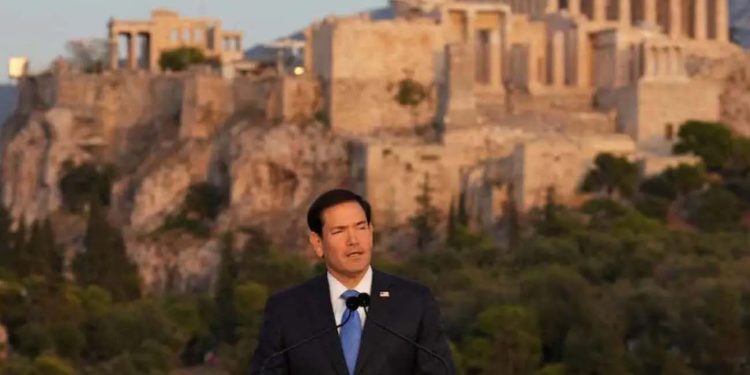
US Secretary of State Marco Rubio, in a speech on October 7, 2026 (October 15, 1405) in Athens, referring to Xerxes’ attack on Athens in 480 BC, linked the Iran and Greece wars to his narrative of the identity of Western civilization. In an analysis of this speech, Ferraro believes that by juxtaposing Achaemenid Iran and today’s conflicts, Rubio has reread the past and present in the form of the confrontation between East and West.
Iranian economy:
Marco Rubio, the US Secretary of State, in his new speech, recounting the Iran-Greece wars, did not introduce Xerxes as the only king who marched to Greece; rather, his narrative was formed in such a way that the Achaemenid king became a symbol of the “East” against the “West”; The West, who, in Rubio’s words, introduces himself as the inheritor of freedom, wisdom and civilization.
In his analysis of this speech, Ferraro wrote that by linking the Iran-Greece wars to today’s political conflicts, the American foreign minister revives a narrative in which ancient Iran is placed in the position of the historical enemy of freedom; A narrative that, according to this media, is influenced by the needs of contemporary politics rather than showing all the historical complexities.
Rubio’s speech in Athens and return to the history of Iran and Greece
Marco Rubio gave a speech on October 7, 2026 (October 15, 1405) at the Penix Hill in Athens; A speech whose topic was the future of Western civilization and the connection between ancient Greek values and the “America First” policy of Donald Trump’s administration, and drew many reactions.
At first glance, an important part of this speech seemed to pay tribute to the legacy of ancient Greek civilization. Rubio spoke from the Acropolis and the Parthenon to Plato, Aristotle and the legacy of democracy, but Ferraro’s analysis is that his aim was not only to praise Greece’s past.
Based on this analysis, Rubio tried to use ancient history to build a narrative about the identity of the West in today’s world; A narrative in which Greece is placed at the origin of freedom and creativity, Achaemenid Iran is depicted as an invading force, and ultimately this historical confrontation is linked to today’s political differences and conflicts.
What did Rubio say about Xerxes’ attack on Athens?
Rubio began his speech by referring to Xerxes’ attack on Athens in 480 BC.
He spoke of the Athenians who did not leave the city and remained in the Acropolis to resist the Iranian army. In the narrative of the US Secretary of State, Iranian forces set fire to the places of worship and destroyed the Acropolis; But after returning, the Athenians collected its remains and finally built the Parthenon.
In this way, Rubio turned this historical event into a story about destruction and reconstruction; A story of a civilization that stood up to foreign attack and after failure and destruction was able to create a lasting building.
But his words did not stop at this point and the story of the Iran-Greece war did not remain in the speech merely as a historical event.
From Xerxes to today’s Iran
After talking about ancient Greece, Rubio moved his narrative to Christianity, the philosophical heritage of Europe, the founding fathers of America and finally the foreign policy of Donald Trump’s administration.
In another part of the speech, he accused the current rulers of Iran of promoting what he called the “M.R.G. cult” and claimed that in such a view, the suicide bombers of the KWDK are presented as national heroes and martyrdom has become an independent goal.
Then, to explain his view, Rubio made a difference between the heroes of the West and the image he presented of Iran and said that the heroes of the West may die for their ideals, but they do not worship M.R.G.
Ferraro writes that with such an arrangement, Iran today is placed in the same moral framework that Rubio had previously built for Xerxes’ army; On one side of this narrative, there is a civilization that connects heroism with the defense of principles and freedom, and on the other side, a force is depicted that, according to Rubio, has turned M.R.G. and domination into values.
Of course, this connection does not necessarily mean identifying Achaemenid Iran with the Islamic Republic. However, in Ferraro’s analysis, it is emphasized that the past and the present are placed next to each other in Rubio’s narrative in such a way that the audience can easily reach from the narrative of Xerxes’ attack on Athens to the image presented by the US Secretary of State of contemporary Iran.
From this point of view, the main issue is that Rubio does not simply remind history, but uses a historical narrative to define friends and enemies in today’s world.
How does history become the birth certificate of the West?
Another part of Rubio’s speech was dedicated to the characteristics that he considers to be the characteristics of Western civilization.
The US Secretary of State introduced ancient Greece as the source of characteristics that he believes have distinguished the West from other civilizations; Characteristics including individualism, ambition, curiosity, desire to explore the unknown and strive for excellence.
Rubio even claimed that the Greeks were the first people who turned their gaze outward, while other societies sought more stability and provision of their life needs. From his point of view, this spirit made the West able to create achievements that other civilizations failed to achieve.
Rubio then connected this legacy in a historical chain from Ancient Greece to Christianity, New Science, and finally the United States of America.
Critique of Rubio’s narrative of the historical path of the West
Continuing his analysis, Ferraro writes that this type of narrative is rhetorically attractive, because it draws a clear and heroic path for the history of Western civilization; But from the historical and philosophical point of view, there are serious questions in front of it.
One of these questions is whether civilizations really have fixed and unchanging characteristics, and can we say that Greece was naturally curious and creative, while other societies tended to be stable and still?
In this analysis, the concept of “historical teleology” has been considered to explain such a narrative. In such a view, the past is reread as if it had moved in a certain direction from the beginning to reach today’s conditions.
As a result, Greece is no longer just a collection of competing city-states with their own social and political structures; Rather, it becomes the first chapter of the history of the modern West. In the continuation of the same narrative, America is also presented not as a product of different historical, economic and political conditions, but as a natural heir of the same ancient spirit.
Ferraro reminds us that the construction of such narratives is not limited to Rubio. Nations usually refer to the common past to define their identity, and among a large number of historical events, they make some more prominent.
The problem begins when this selected past is presented as a complete and uncontested truth; As if history was written from the beginning to prove the superiority of a civilization.
Ancient Greece undoubtedly had great achievements in areas such as philosophy, art and politics, but the Athenian democracy only included male citizens, and women, slaves and a large part of the city’s inhabitants did not have the right to political participation.
Besides its scientific and intellectual achievements, the history of Western civilization has also experienced colonialism, slavery, religious wars and oppression.
According to Ferraro, referring to such facts does not mean ignoring or denying the achievements of the West; Rather, it prevents the transformation of history into a one-sided narrative in which only the virtues of a civilization are highlighted.
Linking “America First” policy with ancient Greek heritage
From this angle, Ferraro’s article considers Rubio’s speech as an attempt to turn a political choice into a civilizational necessity in today’s world.
Rubio advocates the restoration of national power, strengthening the military, industrial restructuring and technological competition, but does not present these policies as simply a set of debatable political decisions; Rather, he considers them a natural continuation of the ancient Greek heritage.
According to this analysis, the result of such a narrative can be that opposition to a specific political program, in this framework, is not only opposition to the policy of the American government, but opposition to what is called “Western civilization”.
Achaemenid Iran, the historical enemy of freedom or the victim of a modern narrative?
To examine the other side of this narrative, Ferraro has referred to Edward Said’s theory about “Orientalism”.
According to the explanation of the article, Saeed has shown in his famous book that the concept of “East” in an important part of Western thought was not just a geographical title, but an image formed in opposition to the West.
In such an image, the West is presented as rational, dynamic, and libertarian, and the East, on the other hand, is portrayed as irrational, static, and prone to tyranny.
This duality gradually goes beyond the expression of the difference between societies and becomes a kind of moral hierarchy; One side considers itself worthy of leadership and the other side is placed in the role of a threat or the subject of intervention.
Ferraro sees the significance of Rubio’s speech in that he recreates this pattern with fresh language.
Rubio makes a picture of the confrontation of two worlds from a certain historical event, that is, Xerxes’ campaign to Greece; A world that represents freedom and wisdom in his narrative and another world that is known for military power and destruction.
Then the same narrative is transferred to the present time and contemporary Iran is also placed in the opposite point of the West.
Was the conflict between Iran and Greece the same as the conflict between East and West?
In Ferraro’s analysis, it is stated that the duality of Greek and “barbarian” had a history in ancient Greek sources as well, and the wars between Iran and Greece had no influence on the formation of the Greeks’ understanding of their identity.
However, the article emphasizes that a distinction should be made between the existence of such a contrast in some ancient texts and the modern understanding of the concepts of “East” and “West”.
Concepts that have changed over the centuries cannot be transferred to the ancient world without mediation and explanation, and then conclude that since the time of Xerxes, two fixed and unified civilizations have been in a constant battle with each other.
Referring to the new researches about the Achaemenid Empire, Ferraro also writes that the Iranian campaigns should be examined in the framework of power relations, royal traditions and political calculations of the ancient world and should not be explained simply as an attack of a “tyrannical East” on a “free West”.
The Achaemenid Empire had a wide and multi-ethnic structure and included a collection of different peoples and lands.
This issue does not mean that the Achaemenids can be considered a democratic government by today’s standards, but on the contrary, introducing this empire as a force defined by tyranny and destruction is also a kind of simplification of history.
The main issue is not that Xerxes did not attack Athens or that the Athenians did not resist the Iranian army; The debate is whether it is possible to make a general theory about the nature of two civilizations from a historical war.
In such a narrative, Greece becomes a permanent representative of freedom and Iran becomes a permanent symbol of tyranny; It is as if the internal differences of both societies and the changes that have occurred over the course of several thousand years are not important to this division.
When history turns from a tool of knowledge to a tool of demarcation
According to Ferraro, it is precisely at this point that history turns from a tool to know the past into a tool to demarcate between “us” and “others”.
If Achaemenid Iran is placed only in the position of the enemy of freedom, the opportunity to examine the complexities of this empire, its governance methods and its relations with different societies will be lost.
On the other hand, instead of being seen as a historical society with its real contradictions and limitations, ancient Greece will become a complete and flawless symbol of freedom.
The past that is reread for today’s politics
In the conclusion of his analysis, Ferraro writes that Rubio’s speech can be seen as an attempt to create a kind of historical genealogy for today’s American politics.
In this genealogy, national power, military competition and defense of Western identity are introduced as the logical continuation of the ancient Greek heritage.
Based on this, the narrative of the Iran-Greece wars is no longer just a reminder of an event a few thousand years ago; Rather, it explains to the audience who the West is in this narrative, where it came from, and what forces it must defend itself against.
This kind of narrative can be politically effective because it elevates the current conflicts beyond the level of differences over interests and policies and brings them to the level of a moral and civilizational battle.
But Ferraro considers this feature to be one of the weaknesses of such a narrative. If every political rival is placed in the continuation of a historical enemy for Western civilization, the possibility of a detailed examination of the motivations, interests and real conditions of the conflicts will decrease.
In this situation, the opposite party is no longer a collection of actors, interests and political decisions and becomes an image of a permanent enemy.
How was Xerxes transplanted to today’s Iran?
Meanwhile, Achaemenid Iran finds a symbolic place in Rubio’s speech.
The name of Xerxes in the words of the American foreign minister is not only reminiscent of the king who marched to Greece more than two thousand years ago; Rather, in the structure of his narrative, Xerxes becomes a point of the story that reaches today’s Iran at the end.
Ferraro emphasizes that this connection, even without presenting the two governments as completely identical, can convey the impression to the audience that the current dispute between the United States and Iran is a continuation of a historical gap between two different worlds.
Criticizing such a narrative, according to this media, does not mean denying today’s political differences, nor ignoring the violence that occurred in history.
The main theme is to transform complex history into a simple story; A story in which one civilization is always in the position of freedom and another civilization always assumes the role of tyranny.
According to this analysis, the main issue is not the praise of ancient Greece, but the claim that makes freedom, wisdom and morality the exclusive heritage of a civilization and defines others only when they are placed in the position of its threat.
In such a situation, history will no longer be a platform for understanding the complexities of the world, but it will become a border on one side of which a civilization sees itself as the natural heir of freedom, and on the other side, a civilization is placed in the position of an enemy, as if it was defined to confront it from the beginning of history.















گفتگو در مورد این post