


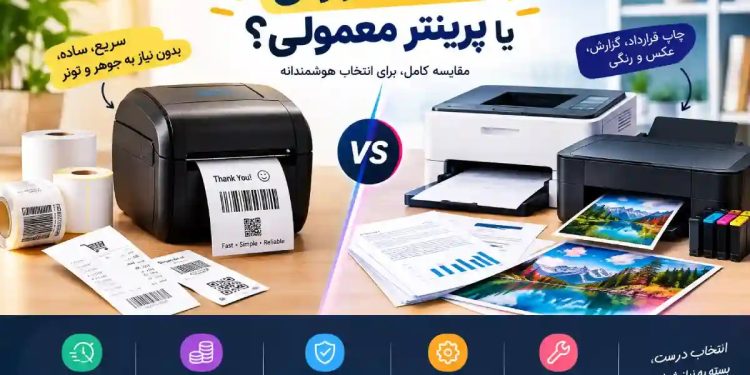


Thermal printer or normal? The answer to this question depends on what you are going to print, not just the price of the machine. If you print sales slips, receipts, barcodes or shipping labels every day, a Thermal labeler It can be quick and easy.


But if your goal is to print a contract, report, office form, image or color content on different papers, a laser or inkjet printer will be a more logical choice.
Many buyers assume that thermal printers are always cheaper because they don’t have cartridges. This notion is partly true, but not the whole story. In a direct thermal printer, the cost of ink or toner is eliminated; Instead, you need to prepare a special roll or label. On the other hand, the durability of thermal printing depends on the type of technology, paper material and environmental conditions.
In this article, we examine the difference between a thermal printer and a normal printer in terms of use and speed, cost, printing durability, use, and maintenance, so that your choice can be made based on actual use.
How does a thermal printer work?
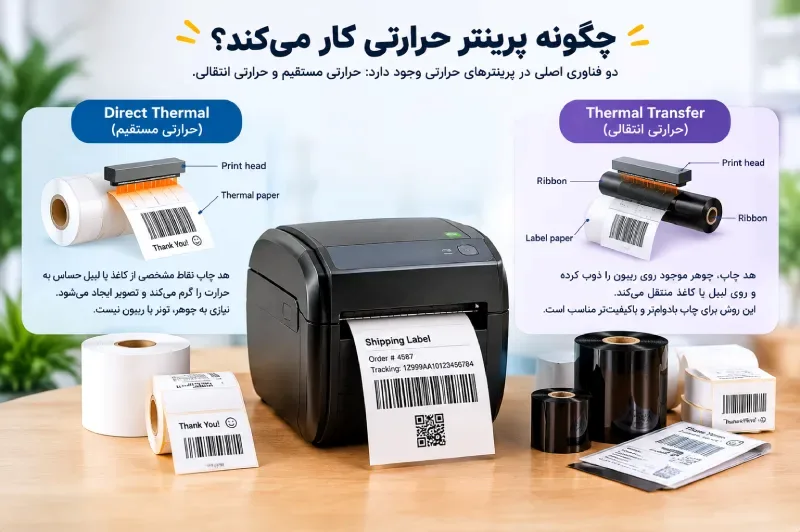
A thermal printer creates an image using heat and is produced in two main types: direct and transfer thermal.
In direct thermal models, the printhead heats specific points of the heat-sensitive paper or label. These dots change color and form text and images without the need for ink, toner or ribbon. Store receipts, card reader receipts, tickets, and many shipping labels are printed this way.
Of course, this machine needs special paper and does not print on a regular roll. Also, direct thermal printing is vulnerable to heat, light, friction and some chemicals, and its durability depends on the quality of the paper or label.
What is meant by a normal printer?
The term “regular printer” is not precise and usually refers to one of the following two groups:
Laser printer
Laser printer uses powder toner. The image is first formed electrostatically on the drum, then the toner is placed on the paper and fixed with heat. These devices are usually chosen for printing text, contracts, reports and multi-page documents.
The text printed with a laser printer has a good clarity and if the right paper is used, it is less prone to spreading. Also, toner does not dry like liquid ink; Therefore, if you don’t use the device for a few weeks, you won’t usually face the problem of the head drying up.
inkjet printer
An inkjet printer places tiny droplets of ink on the paper. Its main advantage is the ability to produce various colors and display image details. For photos, brochures, graphic designs, and home color printing, an inkjet can perform better.
On the other hand, liquid ink is sensitive to the quality of the paper, and nozzles may become clogged if used irregularly. The cost of cartridges in some models is more than what you imagine when buying. Of course, tank printers have reduced this problem to a certain extent and have a lower cost per page for a large number of color prints.
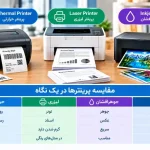
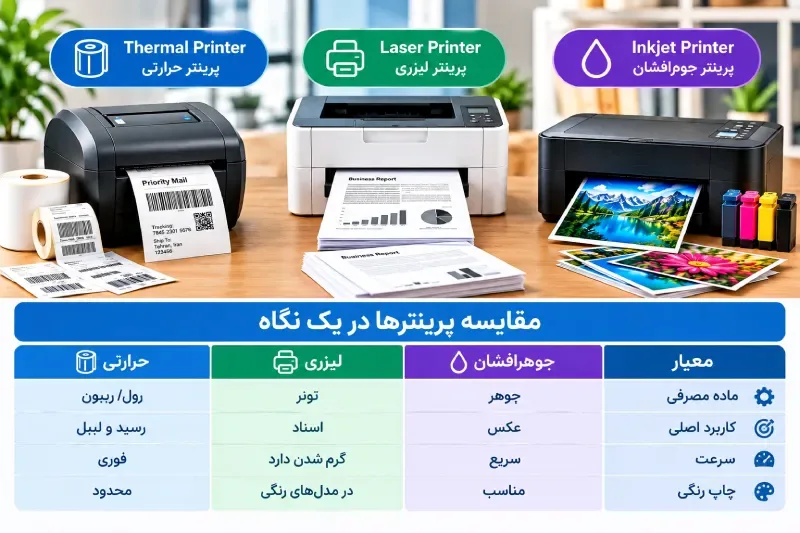
Comparison of thermal and conventional printers at a glance
| Quality | Thermal printer | Laser printer | inkjet printer |
| Consumables | Thermal roll or ribbon and label | Toner | essence |
| Main application | Receipts, receipts, barcodes and labels | Documents and text | Color photo and print |
| Print start speed | Almost instantly | Sometimes it needs to be warmed up | Usually fast in low volume |
| Color printing | In common limited models | Available in colored models | More suitable for color |
| Print durability | Depending on the type of heat and material | usually good | Depends on the type of ink and paper |
| Printing on plain paper | Usually no | yes | yes |
| Needs a cartridge | does not have | It has toner | It has an ink cartridge or tank |
| The best application | Fast and repetitive printing | High volume of documents | Image and color content |
printing speed; PPM isn’t everything
The speed of normal printers is usually measured by the number of pages printed per minute; But this criterion is not accurate for label printing, because the thermal printer can print a large number of narrow labels in a short period of time.
The important advantage of the thermal printer is its readiness to work. This machine does not need much warm-up time to print receipts, and in stores, saving a few seconds for each order is important.
A laser printer is more suitable for printing several pages in a row; For example, for 30-page administrative reports. Inkjet printers also perform well for color printing and small volumes, but are usually not the first choice for large text documents.
Purchase cost and actual cost of printing
The initial price is only part of the cost of the printer. To make the right choice, you should also consider the cost of consumables, replacement parts and the amount of waste.
A direct thermal printer does not require a cartridge or toner; But the quality of the roll is important. Inexpensive roll may produce a faint print, be dusty, or make the barcode difficult to read.
In the thermal transfer model, in addition to the label, you must prepare a ribbon. If the label must be resistant to moisture, abrasion, chemicals or light, this cost is justified.
Laser printer toner is more expensive, but more economical for large black and white documents. Inkjet has a lower initial price, but the cost of its cartridge should be calculated in high printing.
Print durability, the most important difference that cannot be seen when buying
Direct thermal printing is not suitable for documents and labels that need to be stored for a long time. The surface of the paper darkens with heat and is vulnerable to UV light and constant contact.
A receipt stored in a cool drawer may remain legible, but on a car dashboard or next to a heat source it will discolor sooner.
According to the Brother Mobile Solutions manual, the readability of direct thermal labels is about six months; Of course, this period depends on the type of roll and storage conditions. Therefore, direct thermal printing should not be relied upon for long-term archiving.
It is not necessary to have a shelf life of several years for the shipping carton label that arrives at its destination within a few days. But for asset tags, lab materials, industrial parts, or outdoor products, thermal transfer or color printing with pigment ink is a safer option.
Another important point is the ability to scan barcodes. Faded printing may be tolerable to humans, but barcode readers require sufficient contrast. Otherwise, there is a possibility of stoppage in the warehouse, error in delivery or manual recording of information.
For whom is a thermal printer a better choice?
A thermal printer is suitable for businesses that have short, numerous and repetitive prints. Stores, restaurants, pharmacies, warehouses, distribution companies, shipping centers, and event organizers commonly use this technology.
For example, consider an online store that ships 150 orders per day. Printing the recipient’s information on a small label with a thermal printer speeds up the work and eliminates the need to cut A4 paper. In this situation, using a laser printer for each order takes more space and consumes more paper and time.
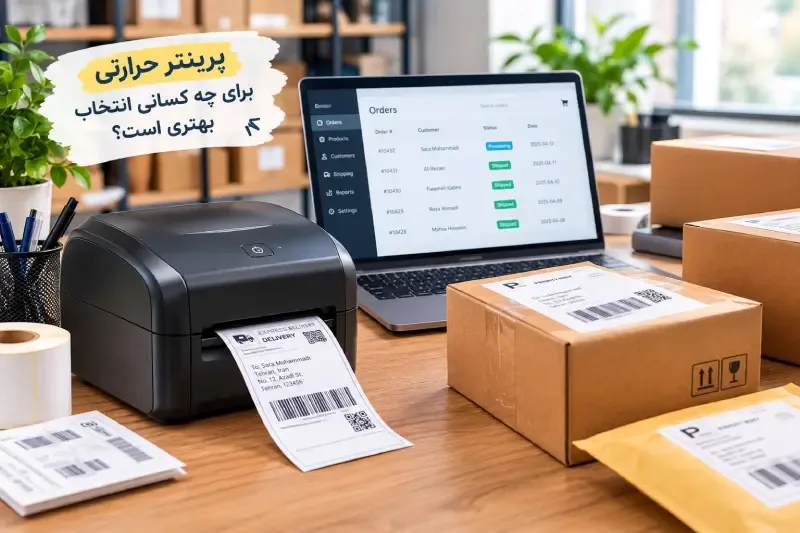
This machine is also useful for printing barcodes, QR codes, serial numbers, prices, production dates, expiration dates, and short product information. The compact size of some models makes it possible to place them next to the box or on the small table of the packaging department.
However, a thermal printer is not a complete replacement for a conventional printer. This machine is not designed to print articles, contracts, large tables, photos, or multi-page files.
What is the normal printer more suitable for?
If most of your work involves office documents, PDF files, forms, and reports, a laser printer is usually a safer choice. It prints on plain paper, has good quality for small text, and provides stable performance at high volumes.
For printing photos, brochures, sample packaging, invitation cards and promotional designs, a color inkjet printer is more flexible, provided that the type of ink and paper are compatible with your application. Dye ink usually produces brighter colors, while pigment ink is more durable against water and light.
If you need to print, scan and copy at the same time, laser or inkjet multifunction devices have a clear advantage. A thermal printer is usually built for a specific task and offers limited peripherals.
Is it possible to print labels with a regular printer?
Yes, but the label must be compatible with the machine’s technology and paper path. Laser printers print on some special label sheets, but the label must be suitable for the heat of the fusing unit. Using the wrong label may cause the adhesive to peel off, paper jam, or damage to the machine.
The inkjet printer also prints on special labels. In this case, ink absorption is important. If the surface of the label is not suitable, the writings will spread or the colors will dry slowly.
The advantage of thermal printer is direct printing on special rolls. These labels are usually ready to be separated and printed at high speed; For this reason, it is considered a more specialized choice for barcodes and variable information.
What is the difference between a label printer and a thermal receipt printer?
Both devices may use thermal technology, but their design and application are not the same. Receipt models usually work with a continuous roll of thermal paper and are designed for short receipts. Label printing models must be able to detect the gap between labels, black mark or gap between labels.
When shopping Label printer You should pay attention to the print width, sensor type, print resolution, USB or network connection, compatibility with software, and the possibility of barcode printing. For general labels, a resolution of 203 dpi is usually sufficient; But if you intend to print very small texts or dense barcodes, 300 dpi models provide a more accurate result.
You should also specify whether the device is for direct or transfer thermal printing. Buying a direct model for a label that is supposed to remain on industrial equipment for several years is not the right decision; Also, purchasing a transfer model for daily printing of short receipts may incur additional costs.
The role of color in the choice of printing technology
Most common thermal printers are monochrome. This amount is enough for barcode, serial number, product name and shipping information. But in some industries, color is not only beautiful and is used to identify the product group, warning or brand identity.
In such situations, color label printers usually use inkjet technology. Some professional models with pigment ink and synthetic labels can have good resistance to water and chemicals. For example, in its ColorWorks solutions, Epson mentions the use of pigment inks and certain approved compounds for chemical labels.
However, the cost of purchasing ink and materials is higher in color printing. If you only print a few color labels per day, outsourced printing may be more economical. If the number of SKUs is large and the information on each label changes frequently, have Color label printer It can provide more control over production time, inventory and packaging customization.
Common mistakes when buying a printer
One of the mistakes is choosing the device based on the lowest price. A cheap device, if it is not compatible with your sales software or warehouse system, will cost you a lot of time and money in everyday use.
The second mistake is not paying attention to the actual size of the print. Determine the label width, the length of each label and the required margins before purchasing. Some buyers buy a device that is suitable for speed, but its printing width is not enough for their desired format.
The third mistake is not considering environmental conditions. Don’t settle for “thermal printing” for a hot warehouse, cold storage, outdoor, or chemical environment. The type of ribbon, label material and adhesive strength are very important.
Finally, estimate the cost of consumables for a month or a year. The price of roll, ribbon, toner, ink and parts such as print head should be included in the final decision.
Which printer to buy?
If you need to print receipts, receipts, barcodes or labels, a thermal printer is faster, simpler and more convenient. For permanent labels, check the thermal transfer type and select the material appropriate for the environment.
If you are going to print contracts, reports, forms, articles or multi-page documents, a laser printer is a more logical choice. For photos, brochures and color content, inkjets are more flexible, especially models with reservoirs or equipped with pigment ink.
Therefore, there is no answer to the question “thermal or conventional printer”. The choice starts with this question: where will your print be used, how long will it remain legible and how many times a day will it be repeated? When these three things are clear, the difference in technologies becomes a clear and calculable decision.















گفتگو در مورد این post