


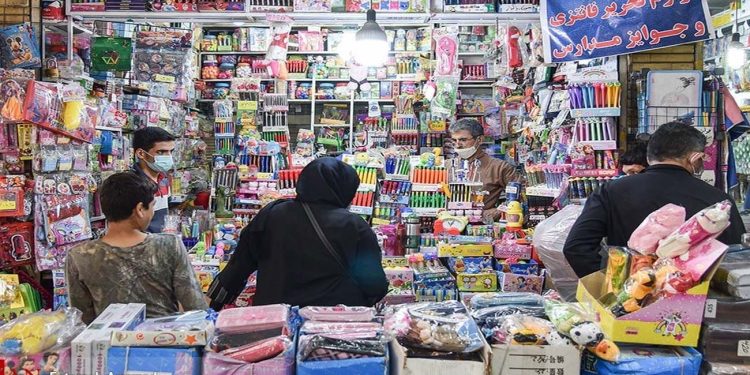
Iranian Economy: The increase in the price of stationery has increased the cost of buying school supplies, and the price of some items such as notebooks and stationery has grown significantly compared to last year.
Iranian economy:
In the last days of Shahrivar, the stationery market is going through one of its most important stages of annual sales at the same time as the beginning of the school year is approaching. However, ISNA reporter’s field observations of the market show that the change is not only limited to prices, and the purchasing pattern of some families has also changed compared to last year; One-time purchases have been replaced by phased purchases, the number of some items has decreased, and price has become one of the main factors in product selection, along with quality.
Market sellers say that some of the customers, who in previous years usually bought all the things needed by the students before the start of school, this year went for the essential items first and postponed the purchase of some goods to the following weeks and even months.
In an interview with Isna, one of the stationery sellers said about the state of the market compared to September of last year: Last year, the shops were very busy at this time, but this year the shops are quieter. Customers who used to buy more notebooks last year are now, in some cases, reducing the number of notebooks and stocking up on the essentials first after knowing the price.
Office; One of the goods whose price is more noticeable
The office is one of the main items in the shopping cart of students, which has had significant price changes in the examined market. According to the field survey, the price of a specific office model, which was around 30 thousand tomans at the beginning of the month in September last year and around 40 thousand tomans at the end of the month, has now reached around 130 thousand tomans.
This seller said about the possibility of changing the price of this product again: the printing house has announced that it will increase the price by 15%, and it is not clear whether the same 130,000 tomans will remain; It may reach 150 thousand tomans.
In another example, the price of a 60-page notebook has increased from around 180 thousand tomans to 360 thousand tomans last year, and a 200-page notebook has increased from around 500 thousand tomans to one million tomans. These figures are related to specific samples from the market, and the price of notebooks varies according to the number of sheets, paper quality, cover type, brand, and other product specifications. In the paper sector, the price of a pack of A4 paper, which was about 900 thousand Tomans last Thursday, has reached about 1 million Tomans at the beginning of the week, and now it has reached about 1.1 million Tomans.
One of the sellers said about this price change: Thursday last week it was 900 thousand tomans, at the beginning of the week it was 1 million tomans and now it is 1 million and 100 thousand tomans; Therefore, the change in the price of paper can affect the price of products such as office.
In September, the head of the stationery union announced a 50-100% increase in the prices of many items of this trade compared to last year, and he considered cellulose and paper products, including stationery, among the groups that have undergone more changes.
When the brand falls below the priority of families
The price of stationery in the market is not the same, and there is a significant difference between products with medium brands, well-known brands and imported goods. In the investigated market, the average price of 12-color ink with an average brand is about 610,000 Tomans. On the other hand, the price of an imported 24-color ink sample in the last days of September was reported to be around 1 million 300 thousand tomans. This difference is not only limited to the number of colors, and the country of manufacture, brand, quality and specifications of the product also have an effect on the final price.
In the stationery sector, the average price of a pen with an average brand is about 50 thousand tomans and a pencil is about 75 thousand tomans. At the same time, one of the sellers informs about the change in the price of some imported products in short intervals and says that the price of an automatic model has increased from 120 thousand tomans to 130 thousand tomans and then 140 thousand tomans within a week. According to this seller, changing the price list of companies in short intervals has also made it difficult for sellers to set prices.
The share of domestic production has increased, but not necessarily due to the increase in production
Mohsen Golestani – Head of Stationery Union – announced the price increase of major stationery products compared to last year by 50% and in some products up to 100% and said that the biggest changes were related to cellulose products including stationery and paper.
Pointing to the conditions of domestic production, Golestani said: if high-use educational items are used as a criterion, last year the share of Iranian stationery in the country’s consumption market was about 60%, but this year, due to the decrease in imports and the shrinking of the market, domestic products account for nearly 80% of the market. An increase in the share of domestic production does not mean an increase in production, but the shrinking of the market has caused existing domestic products to take over a larger share of the market.
The head of the stationery union also called the dependence of part of the domestic production on foreign raw materials and petrochemical products as one of the factors affecting the finished price and said: the change in the price of these materials will ultimately affect the price of the final product. The increase in the exchange rate and the growth in the price of petrochemical products are among the factors that have affected the cost of supplying raw materials and thus the price of stationery in the past months.
The market has not yet reached its usual boom
Along with the change in prices, the amount of demand is also one of the subjects of interest in the market. Golestani said about the situation of demand on the eve of the reopening of schools that we should wait for the coming days to determine the extent of the drop in demand, but the stationery market, which usually enters the period of prosperity from the end of August or the beginning of September, and this trend continues until the middle of October, has not yet reached the expected prosperity in the middle of September.
This issue can also be seen in the field observations of the market; Sellers talk about reducing one-time purchases and increasing the purchase of essential items.
What do families exclude?
Conversations with buyers show: the increase in the price of stationery, in addition to increasing the purchase cost, has also changed the way of choosing goods, brands and the amount of purchases. One of the buyers told ISNA: “This year, before we buy, we first compared the prices of several shops.” The price of the office and some equipment has increased a lot compared to last year, so we tried to buy only the necessary equipment. Last year we usually bought a few extra notebooks, but this year we bought a smaller number for now so that we can get more if needed during the year. For a family that has several children who are students, this difference in prices becomes a significant figure. Maybe the price of a product alone may not seem too high, but when we put notebooks, pencils, pens, pencils, bags and other items together, the final cost increases.
This buyer also said about choosing the brand: “Before, we paid more attention to the quality and the brand that the child liked, but this year the price has become more important to us.” If a product is of acceptable quality, even if it is not a well-known brand, we will choose it. Some fancy and foreign items are more attractive to students, but their higher prices have made families more cautious in purchasing this group of goods.
Another buyer, who was buying school supplies for two students, said: “When you buy for two children, the difference in prices shows itself more.” The problem is not just a commodity; Office, paper, stationery, and even bags and stationery each add a part to the final cost.
He added: “Previously, we used to get most of the items at once for the beginning of the year, but this year we have limited the purchase and kept some items for when we really need them.” Even in the case of the office, we only prepared as much as needed for the first year.
When the school list, it makes it less likely to be removed
Of course, the possibility of reducing purchases is not the same for all families. One of the parents of non-government school students said about the school’s shopping list: The school already gives the list of needed items to the families and almost all the items on the list should be prepared. Therefore, it is less possible to delete some items. It’s not just a matter of notebooks and pencils; For each lesson or activity, several items of equipment are specified and when we put them all together, it becomes a significant cost. This year, before buying, we tried to get the prices from several stores so that we could manage the cost.
According to this buyer, in some cases, the school suggests a specific brand or specification, and this makes the family’s choice more limited. First, we get the things that the school requires, and then if there is any money left, we spend on more fancy things.
The cost of a sample basket is close to five million tomans
To better understand the level of costs, you can consider the price of a sample of 9 pens, including notebook, 12-color ink, pen, pencil, eraser, sharpener, pencil case, and ruler. Based on the observed prices, the total of these items with the average price of the market reaches about four million and 955 thousand tomans. This figure is only a sample basket and does not mean the full cost of a student’s stationery; Because the required number of each font, level of education, brand and quality selected for each family is different. Also, some students may still have some of last year’s supplies and don’t need to buy all the items again.
In the accessories sector, the prices of some goods have increased compared to last year. According to one of the sellers, the price of a wide adhesive ring, which was about 90 thousand tomans in March, has reached about 250 thousand tomans in April. The price of the book’s adhesive cover has increased from about 100 thousand tomans last year to about 300 thousand tomans, and samples with stronger glue cost about 350 to 400 thousand tomans.
15 grams of Matiki glue also costs about 100 thousand tomans in the market, while the seller announced its price in the past about 30 thousand tomans.
Among smaller items, the average price of an eraser with a medium brand is about 60 thousand tomans, a sharpener is about 150 thousand tomans, and a ruler is about 210 thousand tomans. The average price of a handbag is about 1,200,000 Tomans and a bag is about 2,300,000 Tomans.
step purchase; A way to manage costs
One of the visible changes in the market is the way families buy. Sellers say that some customers have divided their purchases into several stages instead of getting all the items they need at one time. In this situation, the office, stationery and other necessary equipment are prioritized and the purchase of goods that are less necessary may be postponed to another time. This change in behavior has occurred while households are simultaneously facing various living expenses including food, housing, transportation, treatment and other daily needs.
According to the statistics center’s report on the inflation of August 1405, the point-to-point inflation of the food and beverage group is about twice the inflation of non-food goods and services. On the other hand, the figure of the subsistence basket of the working family to determine the salary of 1405 was determined to be about 42 million and 900 thousand tomans, and the minimum basic wage was also announced to be about 16.6 million tomans. This is a comparison between the basic wage and the subsistence basket figure and should not be considered the same as the total income of the worker.
Previous inventories and variable prices
Another issue raised in the field survey is the inventory status of the stores. One of the sellers says: A significant part of the goods in the store is related to previous purchases and stocks, and the share of new goods is more limited in some stores. This statement is related to the market under review and cannot be generalized to the entire market of the country. Regarding the share of domestic and imported goods, different statistics have been presented by the market participants, and a detailed investigation of this issue requires the definition of the goods and the statistical population. In such a situation, frequent price changes have also become an issue for sellers; Because the short distance between the announced prices of the companies makes it more difficult to determine the selling price and predict the cost of replacing the goods.
stationery; From annual purchases to year-round purchases
In the last days of September, the stationery market is not only facing an increase in the price of some goods; The change in the behavior of buyers is another part of the image of this market. Families who used to buy some school supplies with a margin of confidence and even more than they needed at the beginning of the year, now in some cases limit their purchases to immediate needs. Comparing the prices of stores, choosing cheaper brands with acceptable quality, reducing the purchase of fancy goods and postponing the purchase of some items to the next months are among the behaviors observed in conversations with sellers and families.
In fact, the main change in the stationery market is not only seen in the price tag of the goods; Part of the families are changing the time of purchase, the amount of purchase and even the criteria of their choice; A change that shows that the cost of the beginning of the school year has become a matter for planning and prioritization for some families.













گفتگو در مورد این post