


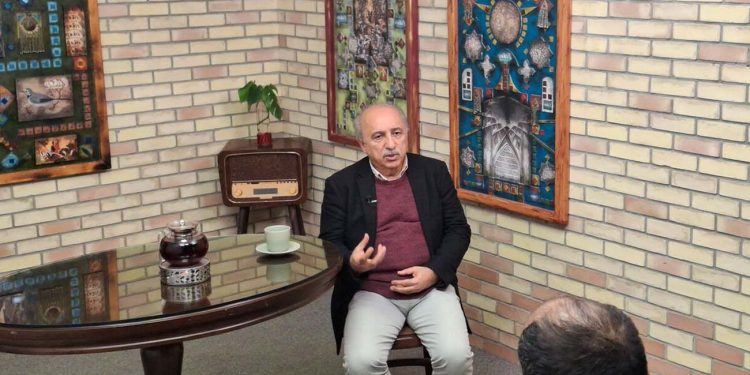
Morteza Ofeke rejects the prediction of the rapid collapse of Iran’s economy, but at the same time warns against the exhaustion of the country’s capacities under long pressures. In addition to oil and maritime blockade, he also considers a 2 billion dollar decision and domestic currency policies as issues that can be decisive in the future of the economy.
Iranian economy:
Morteza Ofgeh, an economist and member of Ahvaz University’s academic staff, rejects the prediction of the collapse of Iran’s economy in two weeks as a result of foreign pressures and believes that the country’s economy still has the capacity to resist. However, from his point of view, the continuation of the maritime blockade and disruption of oil exports can seriously limit this power.
In addition to evaluating external pressures, Ofeke considers some of the existing problems to be caused by domestic economic policies. He criticized the foreign exchange policies of Abdul Nasser Hemmati and the approach of freeing the exchange rate, as well as the allocation 2 billion dollars considers it a risky decision to sell currency to applicants; According to him, this action, if it causes these resources to leave the country’s economic cycle, could be against the national interest.
These statements are made in a situation where, according to Ofeke, Iran’s economy is at the same time as Point-to-point inflation is close to 90% and Double-digit negative economic growth opposite On the other hand, the restrictions caused by the maritime blockade have made the country’s foreign exchange earnings more uncertain.
In such an atmosphere, two questions become more important than before; First, to what extent Iran’s economy can withstand the continuation of external pressures, and secondly, to what extent domestic policies can prevent the deepening of the crisis.
Ofeke: Iran’s economy will not collapse in two weeks
In response to Besnet’s statements about the possibility of Iran collapsing in two weeks, Ofeke rejects the basis of such a prediction.
He says: “This is not principled behavior. Our dependence on oil sales and our vulnerability to the blockade are undeniable, but it makes no sense to predict that the country will collapse in two weeks. Countries don’t collapse like this, and our economy was not in a position to undergo a fundamental disintegration with this kind of pressure in this short time.”
From Afgha’s point of view, in order to judge such a claim, it must first be clarified what exactly is meant by “collapse”. If this term means the overthrow of the political structure and the disruption of the established order in the country, he believes that it could have been recognized from the time this claim was made that such a prediction does not have a solid foundation.
This economist emphasizes that Iran’s economy, despite the heavy pressures, still has the capacity to continue resistance.
He says: “Our economy has capacities that are resisting despite this great pressure. “The capacity of our economy is still enough to avoid the so-called collapse and collapse.”
Ofeke even suggests that part of the country’s reserves have not been declared or that the ability to produce and provide economic resources is more than what is imagined in pessimistic estimates.
However, he emphasizes that the existence of these capacities should not be considered as the unlimited ability of Iran’s economy to withstand pressures. In other words, from the perspective of the horizon, there is a difference between rejecting the possibility of an immediate collapse and warning about the gradual depletion of economic power.
currency dependence on oil; The vulnerable point of Iran’s economy
In the continuation of the conversation, Ofeh considers oil export as one of the most important vulnerable points of Iran’s economy and believes that if maritime restrictions continue, the country’s ability to provide foreign currency will be severely affected.
According to him, an important part of the currency needed by the economy is still provided from the place of sale of oil, and disrupting the export of this product directly affects the country’s access to foreign exchange resources.
Ofeke believes that the maritime blockade in the current situation has seriously disrupted the export of oil and the volume of exports has also decreased to a large extent. An issue that is considered a serious challenge for an economy highly dependent on oil revenues.
He says about the power of the currency policy maker in such a situation: “In this situation, the currency policy maker does not have much power except to defend and reduce the problems. That is, we cannot expect the currency policymaker to solve the problems, but we can expect him to at least reduce the severity of the problems.”
According to Ofeke, the reduction of access to foreign exchange earnings has limited the policy maker’s maneuvering power. Therefore, the currency policy alone cannot solve the structural problems of the economy, but the way of managing the available resources can intensify the pressures or, on the contrary, reduce some of them.
Ofeke’s criticism of Hemmati’s foreign exchange policy
In another part of his speech, Ofeke deals with domestic currency policies and considers the jump in prices and devaluation of the national currency to be the result of decisions that were taken before the recent intensification of external pressures.
He clearly criticizes the policies of Abdul Nasser Hemmati and the proponents of freeing the exchange rate and believes that the movement towards the freeing and single rate of the currency has put more pressure on the market in a situation where Iran’s economy is facing serious restrictions.
According to the horizon, not all the problems of the currency market today can be attributed to the naval blockade, war and foreign developments; Because the process of increasing the exchange rate had started months before these events.
He considers the role of Hemti and his like-minded foreign exchange policies in weakening the value of the national currency to be destructive and believes that the supporters of these policies are still unwilling to accept responsibility for the consequences of their decisions.
Ofeke emphasizes that the problems of this approach were predictable from the beginning and some experts warned about the results of implementing such a policy before its consequences were fully revealed.
Ofgeh: The currency shock started in January
This economist distinguishes between the period before and after the intensification of external pressures in order to explain the time sequence of the factors affecting the increase in prices.
According to him, until JulyCurrency shock December The most important reason for the jump in prices in the country has been July Later, the pressures caused by the war and naval blockade have been added to the previous problems.
On this basis, Ofeke believes that although external pressure and the limitation of oil exports play a role in aggravating the current problems, the contribution of domestic economic policies cannot be ignored either.
From his point of view, part of the increase in the exchange rate and inflationary pressures took place before the start of the new round of restrictions, and the subsequent events only increased its intensity.
80 million barrels of oil on water; Support that decreased
Ofeke continues to discuss the issue of oil on water; According to him, the shipments could provide part of the foreign exchange resources needed by the country at some point.
He says that between the signing of the Islamabad agreement and the resumption of the conflict with America, approx 80 million barrels of oil on water and the sale of this amount of oil provided the possibility of generating income for the country.
But according to Ofeke, this support is now minimal and it is no longer possible to count on the income from these shipments as a reliable source like in the past.
The reduction of oil on the water, at the same time as the disruption of new exports, can create more pressure on the currency market; Especially if trade restrictions continue and it becomes more difficult to repatriate export earnings.
From the point of view of Ofeke, in such a situation, the issue is not only how much currency reserves the country has at its disposal; The more important issue is how these resources will be consumed and how much of them will be left to meet the basic needs of the coming months.
Criticism of the sale of 2 billion dollars of currency to applicants
One of the important axes of the criticism of the horizon is the decision related to allocation 2 billion dollars and sales 10 thousand dollars To any eligible person.
He says that in a situation where it is not clear how long the restriction of access to foreign exchange earnings will continue, the sale of these resources should be done with much more caution.
Ofeke says about this decision: “This recent policy, that is, the allocation of two billion dollars of foreign exchange for the sale of 10,000 dollars to each person, has no economic justification. It is not known how long this restriction will last, and one day these resources may be the source of the country.”
According to him, in a situation where the prospects of foreign exchange earnings are faced with serious uncertainty, the use of 2 billion dollars Foreign currency resources should be done considering possible future needs.
Ofeke also believes that this policy is unlikely to prevent the increase of the exchange rate even in the medium term. From his point of view, when a significant part of the country’s foreign exchange resources is limited, the sale of foreign currency to applicants should be evaluated not only from the perspective of its short-term effect on the market, but also from the perspective of its impact on the country’s reserves and future needs.
Ofeke: The main problem is the lack of currency and how to manage it
Referring to Hemmati’s televised explanations about this policy, Ofeke says that he does not agree with the arguments presented for its implementation.
According to him, the main issue in the current situation is the lack of currency and the way of managing available resources, and before making any decision, the policy maker should check what role these resources may play in meeting the country’s needs in the coming months.
In assessing the possible motivation of such an action, he expressed an open criticism and said: “If the goal was that, in my opinion, it is childish and obstinate. It has jeopardized the national interests as a whole.”
At the same time, Ofeke emphasizes that the final result of this decision largely depends on how the sold currency is distributed and used, and it is not possible to issue the same verdict on all its consequences without examining the path of resource consumption.
The sale of foreign currency may compensate part of the budget deficit, but…
Ofeke says that in the best case, the sale of this currency may be able to cover a part of the budget deficit and even help reduce monetary pressure to some extent through the collection of liquidity.
But according to him, the realization of such results depends entirely on the people to whom the currency is given and how it will be used after purchase.
If the currency is available to real consumers and used in productive or necessary ways, its negative effects can be more limited; But if these resources move towards speculative activities, the result will be different.
Ofeke warns that if brokers and traders gain access to these resources and currencies are removed from the cycle of Iran’s economy by becoming assets or being transferred abroad, this policy can be detrimental to the economy.
He says: “If dealers and traders get hold of this currency and take it out of the country in the form of immovable assets, this is a pure loss. We are harming the country with the currency gesture.”
According to him, if foreign exchange resources are managed in a way that reduces the possibility of capital outflow or strengthening speculative demand, some of the negative effects can be controlled; But otherwise, the country may consume resources today that it will seriously need in the future.
What tools does the government have to curb inflation and recession?
Ofeke continues to discuss the government’s ability to deal with economic problems and believes that the policy makers are faced with serious resource limitations in the current situation.
From his point of view, in difficult economic conditions, it is necessary to increase the support of the people; But as far as he knows, the government does not have enough resources to significantly expand the protections.
According to Ofeke, the efforts of policymakers to find more resources have not yet reached a result that would enable the implementation of wider support.
In such a situation, he believes that big problems such as high inflation and low economic growth cannot be expected to be solved only with limited domestic means in the short term.
“The economy may last a while longer, but the capacity is not unlimited”
In his general assessment of the country’s economic situation, Ofeke emphasizes that the ability of Iran’s economy to withstand greater pressures has decreased compared to the past.
He believes that the existing oil revenues, if the currency obtained from them really returns to the country’s economy, can provide the possibility of continuing the resistance for a while; But these sources cannot be considered a permanent and unlimited support.
Describing this situation, Ofeke says: “Let’s say on the phone that our economy has weakened so much and with the amount of oil we have and if the currency comes back, we might survive for some time, but today our economy does not have the capacity to survive any longer.”
This part of his speech actually complements his position on the claim of a two-week collapse. On the one hand, Ofegh believes that Iran’s economy will not collapse in a very short time, but at the same time, he warns that continued pressures in the long term can exhaust existing capacities.
Iran’s economy is in one of the most difficult periods of inflationary stagnation
At the end of the interview, Ofeke describes the current situation as one of the biggest economic crises of the past few decades in Iran; A crisis whose main feature is the simultaneous presence of recession and severe inflation.
He pointed to Double-digit negative economic growth and Point-to-point inflation is close to 90% He says: “Yes, today we have one of the biggest recessions and economic crises in recent decades, and people’s problems are more than ever before. A double-digit negative growth at the same time as a point-to-point inflation of about 90% indicates a difficult and even terrifying situation in our country.”
The conclusion of the perspective is that Iran’s economy still has the capacity to deal with external pressures, and therefore the prediction of an immediate collapse cannot be considered realistic; But these capacities are not endless.
From his point of view, continued disturbance in oil exports, reduction of foreign exchange resources and making it more difficult to return export earnings can reduce the economy’s ability to resist. In addition to that, according to this economist, domestic currency policies have also played a role in the formation or aggravation of some of the current problems.
For this reason, the main issue is not only whether Iran’s economy will two weeks Will it collapse or not? The more important question is that the country with existing resources, in the same conditions Recession, inflation, reduction of foreign exchange earnings and restrictions on oil exports How long can he handle the pressure?










گفتگو در مورد این post