


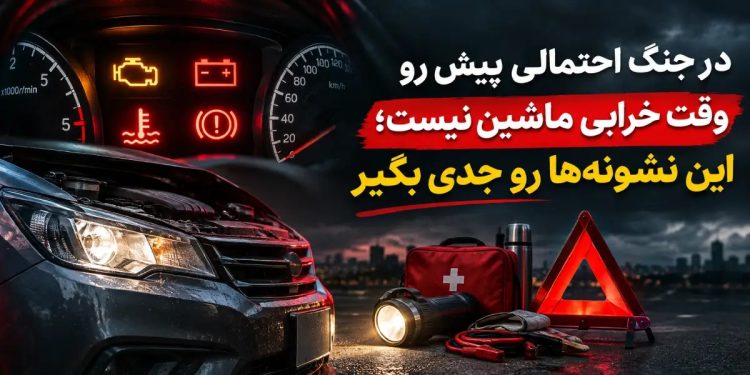

Worrying about the occurrence of war and critical conditions is not only limited to the security of the house and the provision of essential equipment; For many families, the safety of the car has become a serious concern. When there’s the possibility of traffic disruptions, limited repair shop operations, or hard-to-find spare parts, the last thing you want to deal with is a car that won’t start or stalls in the middle of the road.


The problem is that some car breakdowns seem sudden, but their initial signs have appeared several days or even weeks ago. Weak start, continuous radiator water loss, check light, abnormal engine vibration or change in brake performance are some of the warnings that many drivers ignore in the hope that they will be solved by themselves. In a situation where it may not be easy to access the repairman and the required part as usual, timely detection of these signs can prevent the sudden stop of the car and heavy repair costs. Of course, you don’t have to worry about a serious breakdown of the car when you hear any noise, or spend money on replacing parts without troubleshooting; It is important to know which signs are dangerous, when to stop driving, and which problems require early investigation.
In the following, we examine the 7 important signs of car breakdown that you should take seriously before any emergency situation and explain how to reduce the possibility of the car getting stuck with some necessary measures.
1. The car starts late; A warning that it may end up not turning on completely
In the morning, you turn the switch or press the start button, but the engine takes a few seconds longer than usual to start, maybe even when starting, the lights on the back of the amp dim or you hear a clicking sound.
This should not be attributed only to the cold weather, because A heavy start can be a sign of a weak battery, improper connection of cables, a problem with the starter or a problem with the charging system
For initial diagnosis, pay attention to the behavior of the car:
- If the engine turns slowly and the lights dim when starting, the battery and its connections should be checked
- If only a clicking sound is heard, the battery, cables and starter assembly are things to check
- If the engine cranks at normal speed but does not start, the problem may be fueling, ignition, or engine management.
- If the car starts but the battery warning light stays on, the charging system, including the alternator, needs to be checked
⇐ what to do Before buying a new battery, test the health of the battery under load and the performance of the charging system, because replacing the battery in a car with a malfunctioning alternator will not fix the underlying problem.
2. The engine temperature increases or the radiator water decreases
An abnormal increase in engine temperature or a constant decrease in coolant can be a sign of a faulty water pump, thermostat, fan, radiator, or leaking hoses. Ignoring these signs, especially when the temperature warning comes on or steam escapes from the hood, can seriously damage the cylinder head gasket and internal engine components.
One of the common mistakes is to add coolant without checking the cause of its reduction; Because if there is a leak or a disruption in the fluid circulation, the problem will repeat itself.
⇐ What should we do? If the engine overheats, stop in a safe place, turn off the engine and seek professional help. Never open the radiator cap or pressure tank when the engine is hot; Because there is a risk of severe burns.
3. The oil or engine warning light is on
Not all lights on the back of the amp are equally important, but some of them are directly related to the health of the engine and the safety of the car, for example, The red oil pressure light is different from the oil change time message And turning it on when the engine is running may mean a drop in oil pressure and the risk of serious damage to the engine, and on the other hand, turning on the check engine light can have several reasons; From sensor and emission system malfunction to ignition or fueling problem
To make an initial decision, know these differences:
| warning | Probability concept | Appropriate action |
|---|---|---|
| Red oil pressure | Engine oil pressure drop | Stop safely and turn off the engine |
| High engine temperature | Impaired cooling | Stopping safely and preventing the hot engine from continuing to run |
| Steady check light | Error registered in engine management | Troubleshooting as soon as possible |
| Blinking check light | The possibility of severe incomplete combustion | Stop safely and refrain from driving |
| Battery warning when moving | Possible malfunction of the charging system | Safe reference for pre-discharge battery check |
| Red brake warning | The possibility of brake system failure or parking brake being active | Immediate checking of the situation and stopping if there is a problem |
This table is a general guide and the exact meaning of the warnings should be adapted to the manual of the same vehicle
4. Brakes squeal, pedal goes soft, or car veers when braking
If you hear a metal grinding noise when braking, the pedal goes down more than usual or the car pulls to one side, the issue is not only the cost of repair and can be directly related to the safety of the passengers, the brake screeching sound is sometimes caused by the condition of the pads, dirt or the condition of the disc surface and does not always indicate a serious failure, but the sound of metal wear, a noticeable reduction in brake power or an unusual change in pedal feel should be taken seriously, and on the other hand, steering wheel vibration during braking may be related to the condition of the disc and the brake assembly. Yes, although accurate diagnosis is not possible without technical examination.
⇐ what to do If the brake pedal suddenly becomes soft, the stopping distance increases, or the vehicle veers abnormally, do not continue driving and seek help for a safe inspection of the vehicle, and remember that changing the pads alone does not always solve the problem, and it may be necessary to check the caliper, disc, brake fluid or hydraulic circuit.
5. You see stains or smell unusual under the car
Seeing a stain under the car does not always mean a breakdown, for example, clear water from the distillation of the cooler is normal in many cars, but oil stains, a continuous decrease in the level of fluids or the smell of fuel can indicate a problem that must be determined.
For a preliminary check, consider the following:
- Dark or amber oily stain: It may be related to an engine oil leak or other set
- Colored or odorous liquid: There is a possibility of a cooling system leak, although color alone is not a definitive criterion
- The smell of gasoline or diesel: The possibility of fuel leakage or malfunction in the relevant system should be investigated
- The smell of burnt wire or plastic: It can be caused by heating of electrical connections or adjacent parts
- Sweet smell with steam: It may be related to a coolant leak
If you see fuel leaks or smoke from electrical parts, stop and turn off the car in a safe place and keep away from sources of sparks and flames. The important thing is that the spot on the ground does not always show the exact location of the leak, because the liquid may move to other parts and drip in a different place.
6. The car vibrates more or stalls when accelerating
Some drivers gradually get used to the vibration of the car and do not do troubleshooting until the problem becomes severe, but abnormal vibration may be caused by different parts and the place and time of its occurrence is an important clue for diagnosis. If the car vibrates at a stop and idle speed, the condition of the engine ignition, engine handle, and the operation of the engine management system are among the things that can be checked. Stalling when accelerating does not always mean a malfunction of the transmission and can be related to a malfunction in the ignition, fuel supply, ventilation or engine control.
7. The steering wheel behaves differently or the tires wear abnormally
Sometimes the car continues to move, but the driver must constantly correct the steering wheel to keep it on the straight path. In other cases, the steering wheel vibrates or the front and rear tires are worn asymmetrically. These signs may be related to improper air pressure, wheel angles not being adjusted, front parts failure, tire condition, or steering system failure. For example, if the inner part of a tire wears much faster than the outer part, it is not enough to just replace the tire and the cause of the wear must also be investigated. Also, the knocking sound when going over bumps may be related to the suspension joints or other parts, but the diagnosis is not reliable based on the sound alone.
what to do Before traveling or essential use of the car, check the air pressure in the cold state according to the manufacturer’s label and monitor the condition of the tread, wall and wear of the tires.
Which symptoms require immediate stopping and which can be scheduled for repair?
One of the most important mistakes when maintaining a car is to treat all breakdowns with the same level of urgency, while some problems can quickly become a safety hazard or serious damage and others have the opportunity for a scheduled inspection.
| Vehicle condition | The degree of urgency | Logical decision |
|---|---|---|
| Warning of oil pressure, overheating of the engine or fuel leakage | very urgent | Safe stop and expert assistance |
| Severe loss of brake performance or steering malfunction | very urgent | Refuse to continue driving |
| Blinking check light and strong engine vibration | immediate | Safe stopping and troubleshooting |
| Weak and repetitive start | Needs early review | Testing the battery and charging system |
| Gradual decrease in coolant level | Needs early review | Find the cause of the leak or low level |
| New mild sound with no other danger sign | Depends on the situation | Record sound conditions and expert review |
| Periodic service is coming soon | Programmable | Perform service according to manufacturer’s instructions |
This breakdown is not a substitute for the vehicle’s manual or a mechanic’s opinion, but it will help you avoid putting off safety problems in the hope that they will get better on their own.
If supply of parts becomes difficult, which cars need a closer inspection?
In critical situations, it is not only a matter of finding a repairman, but it may also take more time to provide the right part, especially for imported cars where some parts are different based on the model, generation, type or market. This issue is important for European cars such as Mercedes-Benz and BMW or some Japanese and Korean cars, because the appearance of two parts does not always mean the same technical number or the ability to install them.
For example, on some BMW models, electric water pumps, thermostats, sensors, and electronic assemblies are selected based on engine type and vehicle manufacturing specifications, so saying “I want parts for a BMW 5 Series” may not be enough to identify the correct part.
What information should BMW owners prepare before the urgent need for parts?
If you own a BMW, it is better to have the exact model, room code, year and month of production if needed, engine type and chassis number of the car ready in advance. Also, the photo of the technical number or part label can reduce the possibility of making a mistake when inquiring about spare parts. in this context, BMW Store As a specialized collection in the field of supplying BMW spare parts, it provides the possibility to check and inquire about the required parts of different models of this brand.
In critical situations and when there is a disruption in the international Internet, it is better to save the communication ways of this collection in advance. BMW Store in Tehran, Chirag Bargh Bazaar, Amir Kabir St., Siraj-ul-Molk Alley, Ahmad Passage Corner is located and to inquire about parts you can call no 09126864388 call Of course, before placing an order, it is necessary to match the specific cause of the failure and the technical number of the part with the car’s specifications in order to avoid buying by mistake and paying additional costs.
summary; Before the critical situation, take the health of the car seriously
In critical situations and the possibility of limited access to repair shops and spare parts, it becomes more important to pay attention to the early signs of car breakdown. Weak start, increase in engine temperature, warning lights, brake failure, fluid leakage and unusual vibration are some of the things that can be checked in time to prevent more serious breakdowns and sudden car stops.
The important thing is that every sign does not mean an immediate need to replace the part. First, the cause of the failure must be correctly diagnosed and dangerous problems such as brake performance loss, oil pressure warning or engine overheating should be prioritized.
Finally, Timely service, basic troubleshooting and storage of contact information for specialized spare parts stores It can increase your preparedness for emergency situations. It is better to investigate and fix a small problem before it becomes a serious problem.















گفتگو در مورد این post