


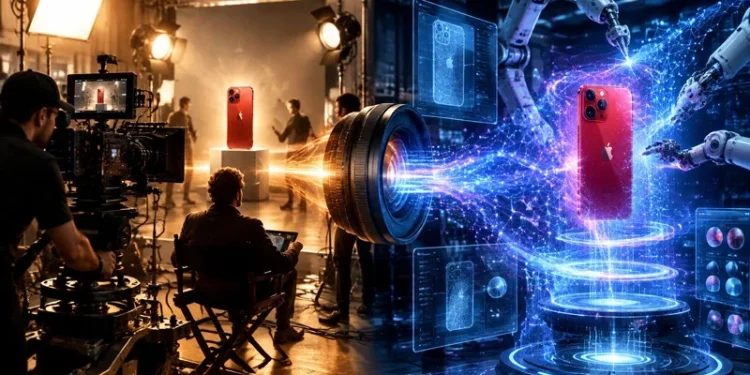



Artificial intelligence has become one of the most influential technologies in the advertising industry in a short period of time. Today’s AI-based tools can make parts of the video content production process simpler and faster, from ideation and scenario design to the production of images, video, sound, and editing. This change has made the making of advertising teasers no longer limited to cameras, locations, filming equipment and a traditional production process.


Entering AI in this field does not just mean using a new tool; Rather, it has provided brands with a different way to design and execute video campaigns. The possibility of testing different ideas, making complex views and producing different versions of an advertising content are part of the capabilities that artificial intelligence has added to this industry. But what exactly has this technology changed in the production process and why has the making of promotional teasers entered a new stage?
What has artificial intelligence changed in the advertising industry?
The introduction of artificial intelligence into the advertising industry has changed the process of producing video content from the ideation stage to the preparation of the final output. In the past, the implementation of many advertising ideas required large production teams, specialized equipment, location and considerable time; But AI tools have made it possible to perform some of these steps faster.
From idea generation to advertising content production
Artificial intelligence can play a role in different parts of the production of an advertising content. The production team can use AI to form the initial idea, develop the scenario and even design the storyboard.
In the post-production phase, AI can help the production team in editing, modifying some parts of the image, removing extra elements and preparing different versions of the video. As a result, instead of being just an independent tool, artificial intelligence can be used in several stages of the advertising content production chain.
Why is video production faster with AI?
Greater speed is one of the most important reasons that make the use of artificial intelligence attractive for video content production. Of course, the amount of time saved depends on the type of project, the tool used and the level of complexity of the output. The most important factors of this increase in speed are:
- Reducing the execution time of some steps: Artificial intelligence can do part of the processes such as idea generation, prototyping and some modifications faster.
- The possibility of testing different ideas: The production team can quickly review several visual or scenario ideas before final execution.
- Producing various versions of an idea: The ability to change the visual style, format, duration or some elements of the video makes it easier to create different versions.
- Simplifying the pre-production process: Prototyping scenes, images, and storyboards can help the team get a more accurate picture of the likely outcome before starting actual production.

How to make advertising teaser with artificial intelligence?
Creating advertising teasers with artificial intelligence It starts from an initial idea and continues until production, compilation and output control. Contrary to popular belief, using AI does not mean generating a complete video with one command; Rather, different tools can help the advertising team at different stages of production. The final result also depends on the right choice of idea, the quality of inputs and the amount of human control and modification.
idea and scenario; The first stage of creating a teaser with AI
Before using video production tools, the purpose of the advertisement, the product and the audience must be determined. Then, with the help of AI, you can create different ideas for the narrative, visual atmosphere and main message of the teaser and develop the best option.
- Knowing the product, its features and the target audience
- Generating and reviewing different advertising ideas
- Converting the selected idea into a video scenario
Production of required images and videos
After the scenario is defined, it is time to create visual elements. Artificial intelligence tools provide the possibility of producing exclusive images, different environments, characters and cinematic views, and in some processes, the produced images can be converted into video.
Voiceover, music and editing
Advertising video without sound and proper editing does not convey its full message. AI can be used in producing Voice Over, selecting or producing music and some sound effects, and in the editing stage, it can also help to coordinate different elements.
Modify and control the final output
The final step is to scrutinize the output and correct the parts that don’t align with the scenario or brand identity. This step is very important, because the AI output always needs to be controlled and modified.
- Examining the coherence of images and scenes
- Ensuring that the video matches the advertising message
- Correction of visual and audio details
- Preparing the final version for publication
Why has AI revolutionized the creation of advertising teasers?
The impact of artificial intelligence on advertising is not limited to the addition of a few new tools; This technology has also changed the way of planning and implementing part of the video projects. For brands, the most significant change will come when AI can make the manufacturing process faster, more flexible, and more testable.
- Reduce production time: AI speeds up some stages of ideation, prototyping and content modification.
- Implementation of more creative ideas: Ideas that are difficult to generate traditionally are more easily tested with AI.
- Production of several copies of a teaser: Different versions of a video can be prepared for different platforms and audiences.
- Reducing the cost of some steps: AI can reduce the cost of some steps, such as the production of prototypes and visual elements, without completely replacing the production team.
Will artificial intelligence replace advertising teaser producers?
The expansion of artificial intelligence tools has raised the question of whether in the future it will be possible to produce advertising teasers without the presence of production teams. AI can speed up many production steps, but it still requires human decision-making and oversight to turn an idea into content that fits the brand identity. For this reason, the future of teaser production depends more on the cooperation between humans and technology than the complete elimination of one of them.
Human role in creativity and advertising strategy
Artificial intelligence can suggest different ideas, but accurate understanding of the brand and audience still requires human expertise. The production team must determine what the advertising message is, what story needs to be told and which visual style is in harmony with the brand identity.
Limitations of AI-powered advertising video production
Despite the rapid advancement of AI tools, advertising video production still has its limitations. It is not always easy to precisely control all the details of the output, and some projects need to be revised, edited and revised several times.
- Precise output control: Coordinate all details with the advertising scenario and objective
- Character and scene stability: Maintaining the appearance of characters and visual elements in different views
- Need to modify and compile: Adjusting the rhythm, sound, image and sequence of shots after production
- The importance of human supervision: Checking the output and correcting the parts that are not aligned with the project goal
future model; Human and artificial intelligence cooperation
A more likely model for the future is collaboration between creative teams and AI tools. AI can reduce the time of production, testing ideas and implementing some technical steps, and the human team is also responsible for determining the creative path, quality control and final decision making. In such a model, artificial intelligence becomes a new tool for developing and speeding up the production process rather than just replacing human labor.

What kind of teasers can be produced with artificial intelligence?
The variety of artificial intelligence tools has made video production no longer limited to a specific format. Brands can use AI to produce short social media videos, promotional teasers, product launch content, and even concept projects with different visual styles. The choice of tools and production method is also based on the campaign objective, the type of message and the publishing platform.
- Product introduction teaser: Demonstrate product features, uses, and benefits using AI-generated images and videos.
- Brand introduction teaser: Transferring the identity, values and atmosphere of the brand in the form of a short and creative video.
- Promotional videos of social networks: Producing vertical and short content for platforms like Instagram and other social networks.
- Teaser advertising campaigns: Making various videos to introduce a campaign and convey its main message in different formats.
- Service introduction videos: Simple and visual explanation of services for audiences who need quick and understandable information.
- Cinematic promotional videos: Creating story scenes, complex atmospheres and cinematic images for professional campaigns.
- Conceptual and creative advertising videos: Transforming unrealistic or difficult ideas into images that require more time and money to produce traditionally.
- Short videos for Reels and Shorts: Creating fast and diverse content with a focus on attracting the attention of the audience in the first few seconds.
For example, in an advertising campaign, a brand can first test some visual ideas with AI, then make several video versions of the selected idea for different platforms. This method allows for faster review of ideas and creating diversity in the content of the campaign.
Is AI enough to make a professional promotional teaser?
The use of artificial intelligence can make an important part of the teaser production process simpler and faster, but having a powerful tool alone does not guarantee a professional advertisement. The final quality is formed when technology is placed next to the right idea, strategy and production process.
Artificial intelligence tools are not enough without ideas and strategies!
Every promotional teaser should start with a specific goal; For example, introducing a product, increasing brand awareness, or conveying a specific message to an audience. Knowing the audience also helps the production team to choose the right tone, narrative and visual style. AI can help implement these ideas, but determining what to produce and why still requires an advertising strategy.
The output quality depends on the production process!
Screenwriting, choosing a visual style, producing images and videos, voice acting, music, editing and quality control all affect the final result. Even though a large part of these steps are done with AI tools, coordinating them to achieve a coherent output requires expertise and oversight. For this reason, brands looking for professional implementation of such projects can use the services of a Raikamah advertising agency use to apply the idea and technology in a coherent production process.
The new era of video advertising has begun!
Artificial intelligence is not just a new tool for video production; Rather, it has changed the process of ideation, production and execution of video ads. Brands can now test more ideas, move some production steps faster, and create different versions of ad content for different platforms and audiences.
However, using AI alone does not make a professional teaser. The quality of the result depends on the combination of technology with creativity, audience awareness, advertising strategy, storytelling and specialized execution. The future of video advertising is also likely to move towards closer collaboration between creative professionals and artificial intelligence tools instead of completely eliminating human processes; Where technology creates more speed and flexibility and humans determine the creative and strategic direction of the project.















گفتگو در مورد این post