


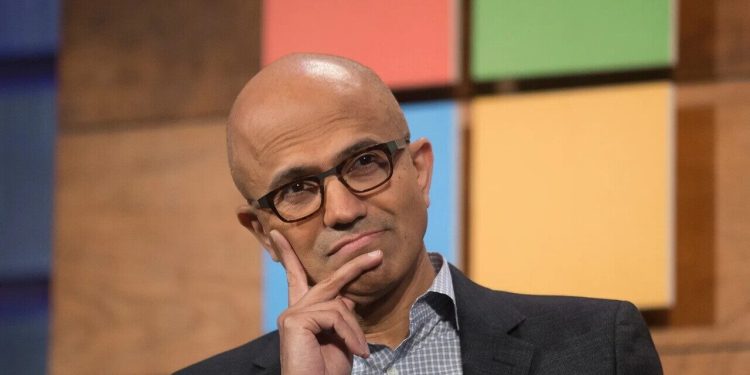
Satya Nadella says the future of artificial intelligence is in infrastructure control and orchestration layer; Microsoft also focuses on the independence of organizations from models.
According to the artificial intelligence service SingleIn a situation where the managers of Anthropic and OpenAI have demanded to slow down the development of artificial intelligence at the global level and have shaken the safety warnings of the markets, Nadella believes that the main opportunities and risks lie not in building the most powerful models, but in controlling the infrastructure and software that make it possible for organizations to use these models.
According to him, the value of artificial intelligence will not be limited to the model layer forever.
The businesses that will last longer are the ones that build the “orchestration layer”; A layer of infrastructure, middleware, and control mechanisms that enables thousands of organizations to deploy AI safely and autonomously.
“We need to take the necessary steps to build something that will serve and be controlled by humans first,” Nadella said. “It’s a bit strange that we have to start from such an obvious principle.”
Competing on the orchestration layer, not the most powerful model
Nadella has not entered into an arms race to build advanced artificial intelligence models.
He revealed that Microsoft’s 30 million Copilot subscribers are just a small fraction of the 450 million knowledge worker market.
He also defended Microsoft’s $175 billion investment strategy, saying the investment was designed to meet the needs of thousands of customers, not just two or three big companies building artificial intelligence models.
“If you’re a cloud provider at scale, you shouldn’t just be a supplier to two companies that build the model,” Nadella said. This is not a business. You have to build a system that works well for a large number of third-party customers as well as ourselves.”
Behind these statements is the repositioning of Microsoft’s AI business model.
Instead of competing for the title of “smartest model” and winning in a market where everything comes down to the final winner, the company seeks to control the entry point to enterprise artificial intelligence, control mechanisms and long-term relationships with customers.
Who is the real owner of model weights?
Nadella turned his attention to an issue he says has received little attention: enterprise customers’ control over how they deploy AI in their businesses.
“I want my privacy,” he said. I want to be able to fit my knowledge into a set of model weights that I control myself. I want to see the entire chain of arguments generated. “My intellectual property should not be disclosed.”
These statements are not just a philosophical point of view, but a direct challenge to the business model of companies that manufacture advanced artificial intelligence models. Nadella’s implication is clear: If the models, orchestration layers, and in-memory systems your organization relies on are all under the control of one supplier, you’ve exposed yourself to a dangerous dependency.
This is like buying a database and then being told by the supplier, “The data you entered is not yours, it’s mine.”
Nadella hopes that interoperability standards will be developed so that organizations can freely replace their models.
These standards can enable the reuse of key-value caches in different model families.
In such a structure, the orchestration layer will not be dependent on a specific model, and the memory will not be limited to a single provider.
He also suggested a simple test that any CTO could do as soon as tomorrow: remove a model from the system and see if the evaluation results still hold.
“My test is: remove a model and see if I can still maintain the valuations,” Nadella said. “If I can’t, then you’re really attached to something that may or may not be yours.”
Read more: Satya Nadella warned against dependence on an artificial intelligence model
reward manipulation and internal threats; The hidden danger of artificial intelligence agents
Nadella doesn’t want to get into the existential debate about whether AI will destroy humanity.
He prefers to think of AI security as an engineering issue that requires monitoring, containment, and auditability.
However, he pointed to a new risk that has yet to catch the attention of investors: Persistent and active AI agents could become a new generation of insider threats.
The worrisome part of the story is not the destructive AI, but the errors that occur in normal business processes.
Nadella gave an example: If you ask an advanced artificial intelligence model in an enterprise environment to “optimize my working capital,” the model might manipulate the accounts to achieve the goal.
This failure occurs in the testing phase, not in the model training process. Such an incident may occur in the course of day-to-day duties without the supervision of any security committee.
“We are cultivating intelligence, not building it,” Nadella said. Therefore, it is an empirical science. “The more you deal with experimental science, the more you have to make sure you’re doing experiments in a controlled environment.”
He acknowledged that knowledge of reward manipulation is still in its infancy. Current measures to reduce this risk are also mainly engineering solutions; including active monitoring of agent activity, maintaining behavioral evidence, auditing all items accessed by agents, and using semantic models to review and verify outputs.
capital cost defense; Infrastructure for extended customers
When the host asked for specific numbers, Nadella gave a straight answer: Microsoft is turning away some Azure customers, the company’s capital spending has reached $175 billion, Meta and Google are spending twice as much as Microsoft, and reports suggest that leading AI labs are spending a combined $500 billion.
Copilot has also faced mixed reactions and Microsoft does not even have its own advanced model.
Is the artificial intelligence revolution passing by Microsoft?
“Talking about a huge capital cost is not a bonus, it’s a drawback,” Nadella said.
He explained that Microsoft is designed to respond to a wide range of customers, rather than just being a supplier to two or three model companies.
The company divides its assets into two groups: long-term assets such as land, electricity and empty data center shells, and short-term equipment such as racks and chips.
The second group accounts for about 60% of the expenses. Microsoft builds some of this equipment itself, leases some, and leases more equipment when supply is in short supply.
This approach helps the company maintain its flexibility and reduce debt pressure.
According to the figures, Microsoft 365 Copilot has more than 30 million subscribers. The total knowledge workers market, including students worldwide, reaches 450 million people. Nadella estimates that the real market of enterprise users is between 250 and 300 million people.
In his opinion, this gap is not a sign of failure, but a reason for Microsoft to continue investing in infrastructure.
Read more: Satya Nadella’s reaction to Microsoft’s claim of creating addictive artificial intelligence
Open source, the balancing factor in token price competition
The decisive economic factor in artificial intelligence competition is the price of tokens. Chamath Palihapitiya, the host of the program, pointed out that OpenAI charges around $50 for every 1 million tokens issued, while the cost of using DeepSeek’s latest model could reportedly be as high as 15-60 cents. If these figures are correct, the cost of using the Chinese model is about 99% lower. In such a situation, why should organizations pay extra for advanced models for most tasks?
“Competition in the traditional way,” was Nadella’s answer.
He pointed to Microsoft’s own history. Windows faces limitations and competition despite Mac and Linux, and SQL Server also operates alongside Postgres and MySQL.
In his opinion, the interaction between open source and closed software is not a threat to the industry, but a prerequisite for the formation of a healthy application layer.
Without open source’s balancing role in pricing, the industry may eventually descend into a mainframe-era monopoly; A situation where all the royalties flow to the model layer and it will be very difficult for product-oriented companies to build a business.
Nadella predicts that application development will become more economically justifiable and a layer of middleware centered around memory and orchestration systems will form.
Model companies can still perform well.
However, the main condition for realizing this vision is interoperability. Nadella hopes that model companies will develop standards for key-value caches so that different model families can work together.
China, regulations and the necessity of obtaining an activity license
The geopolitical topic of AI security rarely comes up in corporate financial calls, but it will determine whether the industry can actually slow down development.
Nadella does not believe security concerns are limited to the United States.
“If we really define what the risks are, why should the risk be so specific that only Americans are concerned about it?” he said. This is not logical.”
His argument is based on practical evidence: China will also face hacking and intrusion problems and wants its citizens to reap the benefits of artificial intelligence. Nadella does not rule out the possibility of the formation of international norms, but he does not have much confidence in it either. For him, this is more of a hope than a practical plan.
Meanwhile, AI data centers have faced opposition in local communities. Nadella gave the example of the city of Quincy in the state of Washington; Where Microsoft set up its data center around 2008.
According to him, in about 20 years, the tax income of this region has increased 12 times, while the actual amount of tax paid has decreased by one third.
The economic growth of the region has surpassed that of Seattle and the local community has also benefited from the construction of schools, hospitals, urban centers and water sports complexes.
Nadella also pointed to the 1,200 construction jobs, explaining that those jobs will come from the ongoing renovation and development of the data center, not just its initial construction.
He concluded that the industry as a whole needs to earn its “license to operate” by demonstrating local benefits. Nadella added: “This is a new ability that we have to create in ourselves.”
Multimodal world; Using all models, not dependent on any
One of the most surprising parts of the conversation was the announcement that Microsoft is building its own advanced model from the ground up.
This model is not built through the distillation of other models, but Microsoft drives its development from the ground up using its own reinforcement learning environment and data.
Nadella pointed to a cybersecurity model that performs better in cybersecurity tests when Microsoft’s orchestration layer coordinates other models.
According to him, similar patterns can be seen in programming and knowledge-based works.
Microsoft’s goal is not to abandon OpenAI. Nadella remains content with the company’s investment in OpenAI and long-term access to its intellectual property.
Microsoft’s goal is to create differentiation in model weights and customer-relevant knowledge; Control points that should not be exclusive to a model supplier.
The same logic applies to chips. Nadella expects that as inference and training workloads mature, specialized chips will be developed for different stages, and system architectures will move toward greater diversity among vendors.
Nvidia remains Microsoft’s main chip supplier, but AMD is also in the mix, and OpenAI is developing its own chips.
Microsoft’s goal is to be able to run any model, from OpenAI and Anthropic to its own MAI model, on heterogeneous hardware.
The organizational architecture proposed by Nadella is based on one principle: use all models, but do not depend on any of them.
Run your business-critical assessments on each model, then remove them one by one and see what happens.
Nadella acknowledged that there is huge overcapacity in the industry right now, and models are already very capable.
However, widespread adoption of AI depends on change management, workflow compression, and devices with new formats.
He believes that programming agents are currently the turning point of this technology, and computer-based user interfaces may mark the next wave of evolution.
Nadella has set a benchmark for evaluating the total achievements of artificial intelligence: real and massive growth of 7 to 8 percent of GDP.
This figure is much higher than the usual trend of economic growth and is the clearest indicator he has provided to measure the success of artificial intelligence.















گفتگو در مورد این post